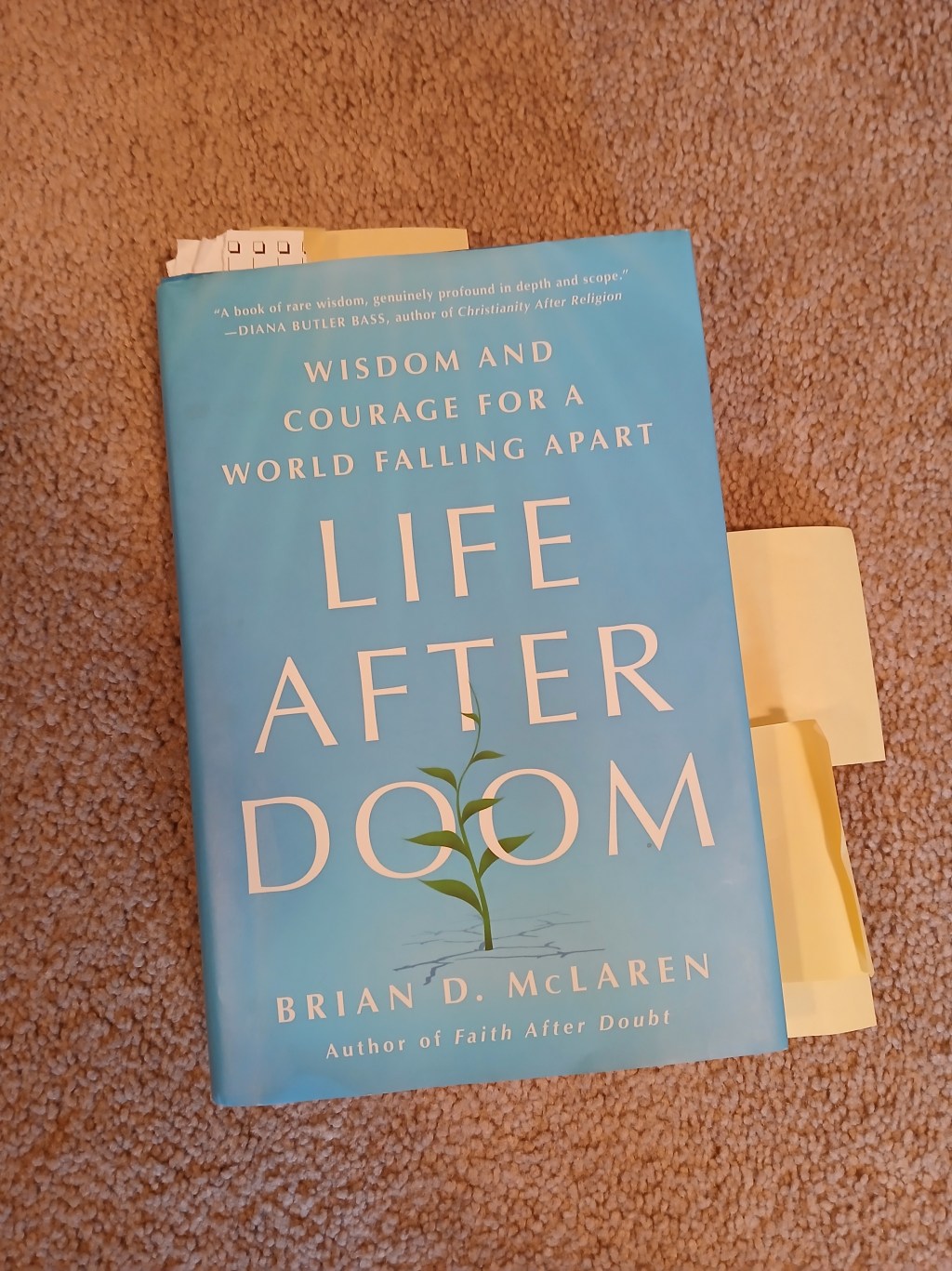
This post is the second in a series of three reviewing the book Life After Doom, Wisdom and Courage for a World Falling Apart by Brian D. McLaren.
***
In the first section of his book, McLaren addresses our natural tendency to turn a blind eye to climate change. He also encourages us to take care of ourselves, particularly our mental health, in the process of waking up to reality. Then he invites the reader to “let be” – to reach a place of insight.
Our civilization has created much good: think of the surgeries that now save lives, the medicines that allow people to live fully, air conditioning in the summer heat, the eating of fresh fruits in the dead of winter, the air travel that allows us to explore our world – I could go on and on listing a multitude of ways our lives have been improved to the point we enjoy longer, healthier lives than ever before.
But, as McLaren outlines so well, there’s the human cost of all this progress. Children mining coltan for our smartphones, increasing asthma and cancer rates due to air pollution, and the ongoing over-heating of our world destroying homes, industries, and lives as wildfires rage like never before. This documentary on the fires in Los Angelos explains how our warming climate feeds fire.
Closer to home, think of Newfoundland and Labrador, and Halifax. Read this news coverage detailing the most recent devastation there.
We are in overshoot, McLaren explains. We take from the Earth more than we repair or return and we spew more pollution than the Earth can detoxify. And Earth is letting us know.
Intertwined with the causes of climate change is our current civilization’s economy which has become so complex it is also fragile and ultimately, not sustainable. Consider how our economy relies on infinite growth in a finite system.
We live in a complex civilization, and it is very difficult, even overwhelming, to decide what needs to happen or whether we can even avoid these crises. We are not the first civilization to face the ending. Consider the Roman Empire, the Mayans, or our own Indigenous of Turtle Island. In fact, McLaren devotes an entire chapter to what we can learn from our Indigenous peoples. Consider that the collapse of our civilization, which has been shaped by the domination of colonial exploitation, might be viewed as a liberation by some.
One of the many, many resources that McLaren recommends to his readers is Sid Smith’s How to Enjoy the End of the World series on You Tube. I listened to this and it gave me a whole new perspective on the use of energy in the creation of past cultures and the astronomical trajectory that led to our current complex civilization. While Chapters 1,2 and 3 are an academic review of the laws of energy and thermodynamics (I have forgotten my high school physics classes, sorry Mr. Finch), and what is actually meant by a “complex” society, I found them a fascinating base for understanding his later videos on energy in the creation and fall of civilizations. In particular, his final chapter at the time of my posting this blog is Chapter 5 and it clearly explains ecological overshoot. If you pursue this, be sure to listen to his Prologue: Why You Shouldn’t Let Collapse Get You Down, first and his next video entitled Whaddya Mean Collapse?
Back to the book, McLaren explains our addiction to cheap fossil fuels as something that we will find very difficult to eradicate. Even our industrialized food production relies on fossil fuels (which is explained very well in the above video series).
McLaren compares the process we need to follow to what Alcoholics Anonymous (AA) asks of its members. The first step for a member is to admit addiction and that life has become unmanageable. McLaren declares,”Our civilization is powerless over our cheap energy addiction; our civilization has become unmanageable and needs to be restored to sanity.”
It’s unmanageable because in overshoot we are caught in a vicious cycle; we need to remove resources from the Earth to support our economic growth and for food production, but that growth will “intensify and hasten ecological collapse.” Put another way, we use up farmland to build new industry (to provide jobs which give us the income to purchase food) which results in damage to water sources and precious eco-systems, and less farmland to grow our food.
Where and how do we get off this merry-go-round?
McLaren quotes the Serenity Prayer used by AA: “God, grant me the serenity to accept the things I cannot change, the courage to change the things I can, and the wisdom to know the difference.”
The wisdom to know the difference is an area of much debate when it comes to what will reduce the impacts of climate change. He cites the examples of renewable energy, such as solar and wind, or electric cars and heat pumps, but then notes “massive amounts of copper, aluminum, cobalt, graphite, and manganese, along with rare earth metals, especially lithium” will be needed which will require “huge quantities of fossil fuels to mine, transport, and process these raw materials.”
Many solutions result in more ecological damage to our Earth – in other words, more problems. In addition, these resources are primarily on Indigenous lands. How will they be treated? “Other resources lie beneath forests and other delicate ecosystems; again you wonder how many will be sacrificed for our climate emergency,” McLaren asks.
Something I have been repeating to myself a lot lately is McLaren’s Chapter 10 title, “Maybe It’s Good, Maybe It’s Not.” I have used it when reflecting on the minor irritations and celebrations in life but also when thinking about the big issues. There’s talk of an east-west pipeline across Canada which would require extensive use of land, including Indigenous land, and cause significant damage. That’s bad..isn’t it? It would reduce Ontario’s reliance on U.S. gas and also open the opportunity to export gas to countries that could then replace their use of coal, a fuel which causes tremendous harm to the environment. That’s good… isn’t it? An east-west electricity grid, supported by clean energy would benefit everyone…maybe/maybe not?
In a world that is increasingly polarized in its opinions, we could all use a good dose of maybe it’s good, maybe it’s not. As a former colleague used to say, it’s a pretty thin pancake that doesn’t have two sides.
And so, McLaren invites the reader to get beyond our bi-polar views, “this” is good and “that” is bad, and helps us to question what may be conventional wisdom for our current civilization. He asks instead, “Are profitable quarters and big returns for shareholders always good? Is a declining GDP always bad? Is growth in the number of billionaires always good?”
I recently published a memoir of my parents and included a lot of ancestral history. It’s a story of multiple generations working to improve their lives and it haunts me to think that my husband and I, and our children may be the last generations to experience that upward mobility. Will a decline in circumstances become the norm for future generations? Is that bad? Is that good? How can we prepare them? In order to get ahead, do we need to go back? How far back?
These questions may be more than academic in the face of the looming climate crisis. When we are prepared to question, to challenge what has been conventional wisdom, then perhaps we will open ourselves to the possibility of an alternate, more sustainable future.
There’s a lot of negativity in this reflection. I am writing about a book with the word “Doom” in its title and I am recommending you listen to a YouTube channel that suggests we enjoy the end of the world. McLaren takes this head on and leads the reader to what feels like an inevitable discussion about death. As a woman about to enter her 7th decade, I connected with the author’s description of life and death, that we must abandon our fear of death and instead realize we may have limited time here, and with that time we have a choice: keep destroying our precious environment or we can “leave our descendants with a habitable world and the skills and virtues to flourish in it.”
With five grandchildren, I know what my choice is.
Here’s a reflection for you to consider as I bring this post to a close: If you were facing the possible ending of the world, and you had a choice, how would you describe where you are, what you are doing, and who you are with?
Next week: Let Come
***
1. Life After Doom, Wisdom and Courage for a World Falling Apart, Brian D. McLaren, St. Martin’s Publishing Group, New York, 2024
2.Inside the LA Firestorm – The Real Story – Documentary, PBS Terra, YouTube, Accessed August 13, 2025.
3. CTV News, Thousands in St. John’s on evacuation notice as wildfires continue to spread, accessed August 13, 2025.
4. How to Enjoy the End of the World, Sid Smith, You Tube http://www.youtube.com/@bsidneysmith/ , accessed Aug. 13, 2025.
 StillKim