If you have ever thought about getting off the merry-go-round and away from it all, find out more about what’s involved in this lifestyle choice in this week’s blog post. This is Part 2 of a story detailing the off-grid retirement life of Marion Duke, former editor of The Listowel Banner.
***
Living off the grid occupies much of Marion’s time and focus, but that is how she wanted it. She counts the need to keep physically busy in order to live as one of the best things about her life now. It appears to be working as she enjoys good health in these later years of her eighth decade.
She had 23 feet of snow last winter. “All I did was shovel paths to the bird feeder, the solar panel and the woodshed. And kept two stoves going.
“I don’t have a gym membership,” she jokes.
In the winter, she is up early to get the fires going in the two stoves; her morning routine includes a cup of beet juice, a tablespoon of golden raisins that were soaked in gin, and two dates. Then she is outside shovelling, returning indoors to enjoy a late breakfast. When not shovelling, she’s on her snowshoes or cross country skis. In the summer she is up earlier to beat the heat and cools off in the Magnetewan River that runs about 50 feet below her log home.
She also enjoys night sky views through a telescope in the observatory her brother helped her to erect on the property.
The idea of living this way began to take shape before she retired in 2005. The two-story log home was built in the 90s. She wanted to keep active after leaving work – the idea of a retirement home is abhorrent to her. “I’ve seen enough of them and we do a horrible job of looking after our elderly.”
The isolation was also appealing. “When you come from a large family, you either want to repeat that, or you want your privacy.”
Marion has her privacy now. The longest stretch she has gone without seeing another person is approximately two weeks. She drives into town every eight or nine days for shopping and laundry. She has only a small freezer in her propane refrigerator and no washing machine as such larger appliances would take too much power. The road she lives on is rough and can become impassable, usually about three days every spring and in the winter during heavy storms. She maintains a supply of canned and dry food in her cupboards for times she can’t get out.
But she also sees family on a regular basis such as on long holiday weekends and at Christmas; a brother and sister-in-law visit each summer and each spring and fall she returns to the farm in Howick to spend time with family.
She protects her privacy – and the energy to run her home. She has a flip phone (it uses less power than other models) but keeps it off during the day and only turns it on for a couple hours each night for family to reach her. As isolated as her life sounds, she stays in touch with the world. She has Sirius XM satellite and listens to all the broadcasts to remain informed. And she’s a baseball fanatic. Yes, she has a television for news and sports, but reading is also a passion.
The prime attractions to moving back to the family’s original land were the air, because it’s more acidic which is better for her asthma, and the excellent water she gets from an artesian well on the property.
Off grid has been a learning experience. In her first winter, she had to chop a hole in the river to get water when her well was inaccessible. When the river is at flood level, it is above the well and caps the source. When this happens, she waits for the water level to lower and for the flow to clear naturally, sometimes a three-week process. At these times she can get water from an artesian well in Sundridge which all area residents access.
She ran out of wood her first year and she learned about the ash dump in the chimney. “I didn’t know enough to empty it the first year.” She had trouble with smoke and had to ask a friend for help. She explains, we don’t live in each other’s homes, but we can rely on each other. Her closest neighbour is half a mile up the road. When she first moved, her mailbox was the second in the area, now there are five others. She is the last permanent resident on the road.
Her six-panel solar system feeds eight large industrial batteries in the basement; these store the power and an inverter converts the energy that powers her lights, television, satellite radio, and water pump. The biggest power user is the water pump in the well. She added a propane generator in 2006 which runs the stove, fridge, and hot water heater.
It isn’t cheap to live off-grid, she explains. The cost to fill the propane tanks has gone from $400 when she moved in to $800 now; the cord of wood that used to be $50 is now $145; and the cost to replace the batteries that store the power in the basement would be $7,000 per change. She’s been through three generators in the 21 years she has lived there and has replaced batteries three times.
Life isn’t without some risk. She recently suffered an insect bite despite having her skin well-covered while she was clearing debris after several dead Spruce had been removed from her driveway. She didn’t see the insect and there was no definite mark, but a bit more than week later she became extremely ill, shaking the bed as she shivered from severe chills. Her sister, a retired RN, told her she had the classic symptoms of a tic bite.
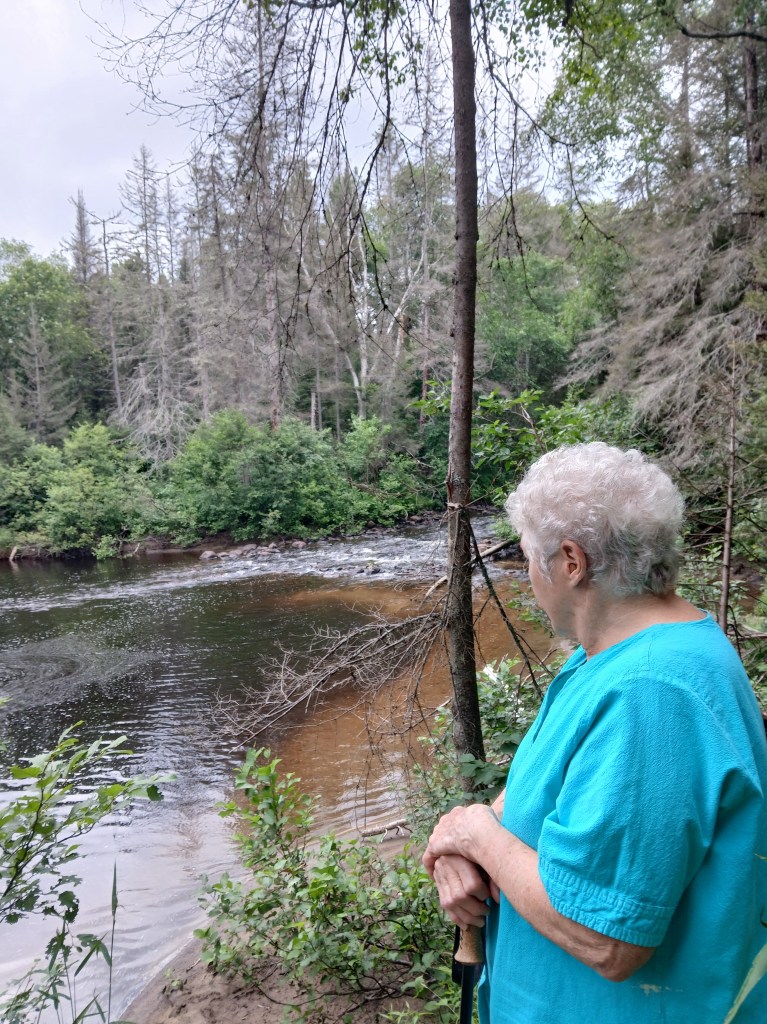
But she has a front row view of nature and lives in harmony with its inhabitants. Bears cross her yard on occasion, and moose are frequent visitors. In June as she was piling cords of wood that had been delivered, she heard a pack of wolves that drowned out the radio she had blaring. “They must have had a kill,” she muses. “It’s unusual to hear them anytime, but 7:30 a.m. was most unusual.”
She is also aware of the changes happening in nature. In recent years that has included the Black Spruce dying out due to Gypsy Moth invasions along with a reduction in the number of bird species. For instance, she hasn’t seen Grey Jays in at least seven years. These birds are considered year-round residents of Ontario’s boreal and mixed coniferous forests. The species, Marion explains, have a sticky part on their mouth to hold food which they then put on the bark of the tree so they can return for it later. Now the Black Spruce are dying and the birds have left.
It’s not the lifestyle for everyone, but Marion loves the privacy, fresh air, and good water. The dark skies give her ample opportunity to view the universe through her telescope. The time and ability to observe natural life is appealing and when she wants to get back on the merry-go-round with others, she has that option too.
In a world that feels continually chaotic, I think she’s living the dream!

