• Resume versus Eulogy

    Resume versus Eulogy


    I recall my father telling me, with a hint of surprise in his voice, that he had fewer years left than what he had lived already. It was a concept I could not (or did not want to) fathom in my young adulthood. But now, suddenly it seems, I get it. Some days better than others.

    ***

    I have been doing a lot of thinking about resume virtues versus eulogy virtues lately. I was introduced to the concept in a writing workshop, The Wisdom Years, where we read an article by David Brooks, a cultural commentator for the New York Times and a Ted Talks presenter

    Brooks wrote that we have likely spent much of our lives focused on our resume virtues, those skills and values that framed our careers, and our efforts to earn a living. I identified with his reflections about this. To prospective employers, I listed the skills that I possessed which would support the company’s goals. Or, later in my career my focus was on developing my expertise so that clients would be willing to pay for my consultant services. I honed skills in areas such as punctuality, accuracy, technology, leadership, effective presentations… and even returned to school ( in my 50s) as I sought promotions, titles, and pay increases. Resume skills were an area I taught to students as a college professor.

    On the other hand, eulogy virtues, according the Brooks, may not have been given the same amount of attention yet they may be more important. These are the parts of our personalities that are responsible for the relationships we developed and nurtured throughout life, not in return for a pay cheque. The idea created questions for me such as, have I been a compassionate friend who supported others through the thick and the thin of life? Have I shared my time and gifts in making the lives of others easier, more joyful, or meaningful? Are my exchanges with others designed to build them up? Am I present or mindful in my interactions?

    As Maya Angelou expressed it: people may forget what you said or did, but “people will never forget how you made them feel.”  How do people feel after interacting with you? Think of those people who make you feel better about yourself, or loved, after an encounter. What’s their magic sauce?

    In the workshop we were encouraged to draft our own eulogy with the thought, how would I want to be remembered? And if we have not been drawing on those eulogy virtues, perhaps it is time to focus on them, to bring them to the forefront as we consider how we will spend these wisdom years, the time when for most of us, our careers and work lives are over. 

    It was a compelling exercise… and then I attended two funerals. 

    The first was for a 90+ year-old woman who had been a wife and mother, who worked outside the home and raised two sons. It was clear in the remarks from her grown grandchildren and her daughter-in-law that this woman had lived a eulogy life. Her job in a law office was worth about two lines in one of the presentations. The rest talked of how she made her children and grandchildren feel safe and loved because of her quiet, steadfast, and supportive presence in their lives, including air travel to attend a wedding in western Canada when in her 80s. It was a true testament and celebration of a life well-lived and appreciated for her love, compassion, and time and attention. 

    The second funeral was more challenging as it was for the 71-year-old husband of a long-standing, good friend. He had just fully retired 3 1/2 months prior and his death was sudden. This man was a veterinarian who brought compassion to the care he provided to both large and small animals over his career and yet, his work life was just a side-bar to the stories that were shared at his funeral by his close friends and his three children. It was clear that his humour and his caring heart made life better for others. He was a good friend who took the time to tell others how he felt about them; as one described it, he had empathy for others. He was the glue that brought everyone together. I know from personal experience that he sought to build bridges of understanding between people in a quiet, respectful manner. Grown men were unashamed as they shed tears because of this loss. His daughter told us she had received a message from him just days before his death in which he told her how proud he was of her. The kind of message we are told time and time again to send, send, send NOW! Don’t wait! The funeral was also a reminder to us all that we have a finite time, and I have no doubt that many of us asked ourselves on the way home, what are we doing with that time?

    My reflections turned to my mother, who in her 60s told me she was still waiting for something, some “more” to life yet, and this “something more” remained elusive. She struggled to define it. 

    At this stage of life there does come a niggling thought that, surely there’s more to life. Talk to most people and they will express the thought that It all happened very quickly. Are we really this age, already? 

    Perhaps it is in the restlessness one feels after retirement when we have a new sense of time and freedom… when we ask, what now? When those work skills we so carefully developed in earlier years don’t seem so important anymore. 

    Perhaps it is because we are struck with the sobering thought that we have lived more years of our life than what we have left. How we invest our time now is more important than ever, and my friend’s funeral brought that fact home. And, I was humbled by the realization that my friend had shared his eulogy virtues throughout his life.

    For some of us, perhaps now is the time to think about the virtues we might have ignored or set in the background as we built careers. When our time was limited by the competing demands of career, marriage, kids, family obligations etc.  Now we have time to focus on those values that move beyond the trappings of stature or career. Perhaps now is the time to focus on what is really important: our relationships with family and friends. 

    In the Hindu faith, this time of life is referred to as the “vanaprastha” years, when the elder members leave the household duties to the younger and take on the role of advisor or guide. It can also be a time of spiritual journey, of introspection, a time to recognize we are not immortal. 

    My mother was clearly doing some introspection when she wondered, what now?, after successfully raising five kids. I hope she had others to talk with, others who would be able to recognize the reflection that was going on behind the words. Such sharing can enrich life when we meet others who truly see us.

    How are you experiencing the “vanaprastha” time of your life? What do you think about the concept of resume versus eulogy virtues? How do you enhance your important relationships? Is there someone you need to connect with now?

    ***

    Read David Brook’s full article here: https://www.nytimes.com/2015/04/12/opinion/sunday/david-brooks-the-moral-bucket-list.html#:~:text=It%20occurred%20to%20me%20that,you%20capable%20of%20deep%20love%3F

    David Brooks Ted Talk https://www.ted.com/talks/david_brooks_should_you_live_for_your_resume_or_your_eulogy

    If a writing workshop on The Wisdom Years appeals, check it out here: https://thestoryguides.com/the-wisdom-years

    Vanaprastha: Becoming Conscious of Your Mortality, https://isha.sadhguru.org/en/wisdom/sadhguru-spot/vanaprastha-becoming-conscious-mortality

  • Making change

    Making change

    I’ve never been one to fear change; in fact, I thrived on it. Or so I thought. 

    Then my husband and I decided to move, something many people at our stage of life do. We moved from the 34-year old multi-level home we built in 1989 to a bungalow on a smaller lot.

    While I’d thought about moving for some time, it was theoretical. When it happened, it felt sudden. New home.  Different neighbourhood. Same town. So, not that big of a deal, right?

    I have often been unsympathetic with those who fight change. Get on with it, I would think. Yet in my new home I felt a level of anxiety that I was unable to explain. Even as I painted and papered and decorated – a past-time I love – to make the space truly ours, the unsettled feelings persisted.

    Research into life changes was revealing. It seems I underestimated the transition that this change in address sparked, and I was likely burying the emotions that accompanied it. 

    Some changes in life are truly minor, while others prompt a major transition in life. According to researcher and TedTalks presenter Bruce Feiler, selling our family home would have been a lifequake for us. “A massive burst of change that leads to a period of upheaval, transition and renewal,” Feiler explains the term.

    Such lifequakes can be a move, like ours, or can be precipitated by a change in career, health or finances; the death of a loved one; an unfulfilled goal; or a change in a significant relationship. He distinguishes between lifequake changes that we choose and lifequakes over which we have no control – such as a death or a world pandemic.  

    While how we experience these lifequakes will vary depending on many circumstances, Feiler suggests life transitions share three phases in common: 

    1. The long goodbye 

    2. The messy middle, and 

    3. The new beginning. 

    He emphasizes these are not necessarily experienced in a linear fashion. 

    I have begun to respect the psychological impact of our move and the source of my anxiety. We were saying goodbye to that chapter in our lives where we were in building mode – building a family, building our careers, building a home.

    Phase 2, or the messy middle, may have been the literal mess of drywall dust as we finished off a basement in our new home, but I think now my anxiety was indicative of this middle phase of our transition. Although I thought I thrived on change, my body was telling me something different about this particular change. For the first time, we had made a decision based on the fact we’re aging and the realization there’s fewer years ahead than behind us.

    Dealing with this has been a process and while the anxiety has all but disappeared, at times we continue the long goodbye, while at the same time try to embrace the new beginning of Phase 3 – that is living our lives cognizant of the fact we are in the final years of the journey.  Not to be too negative – my 94-year-old mother-in-law would tell me there’s a few left yet!

    Feiler says when you are in a transition you should start with the phase where you are at your best because that’s where your power lies. I’m best at new beginnings so my furious pace to paint, paper, and redecorate was the right approach for me. It also explains why I was the one to rip off the bandage, so to speak, and initiate the move.

    He also advises to accept your emotions and that for the vast majority of us, rituals can help. 

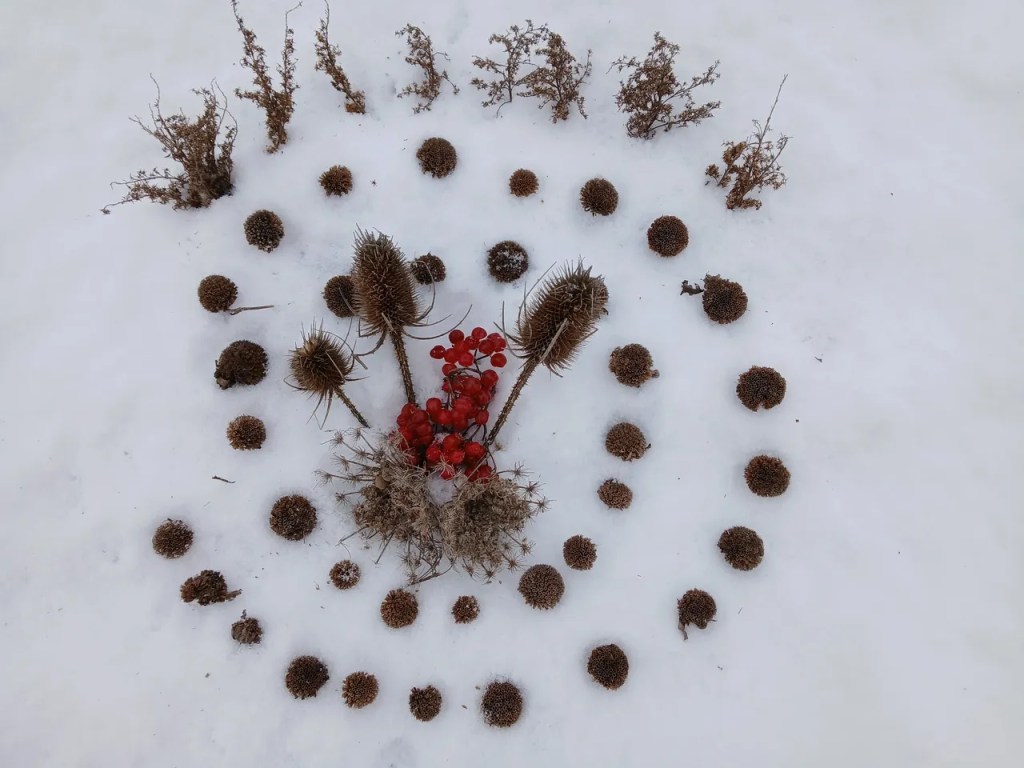
    In January I participated in a writing workshop called The Wisdom Years. I will share more of my learnings (like the three phases I noted above) from the course in future posts, but I’d like to explain our first assignment, which was to create a Morning Altar. 

    The task was to go into nature and create an altar out of whatever we might find – flowers, twigs, rocks etc. and get creative. We were to name the person or the thing that we were saying goodbye to and then, we were to walk away and allow nature to take over the altar, recognizing that nothing in life is permanent. Everything is always changing. 

    The assignment was not my cup of tea as I’m no artist, but I’m willing to give most things at least a try. 

    My finished altar is pictured with this post.

    Despite my initial hesitation, the impact of participating was surprisingly profound and contributed to easing the anxiety I was feeling. At first, I thought I did this to say goodbye to or let go of the life I have led. Goodbye to the building chapter of my life. 

    Starting with no real plan, what began to develop as I worked on this art was a labrynth. As you know, there is one path to walk forward in a labrynth and you can choose to return following the same path, unlike a maze that may have multiple ways in and out and dead ends. Labrynths can be spiritual and prayerful. A method for contemplating life.

    As I struggled to make meaning of the labrynth, my reflections resulted in the decision to dedicate the altar to the life I continue to lead.  Not to what I was leaving behind. 

    Although life can take many different routes, like a maze, we have only one life, and it moves forward. Like a labrynth leading to its centre.  That’s what I need to embrace, that I am still on the path and there are still new discoveries – and more changes – yet to come. 

    “No doubt the universe is unfolding as it should,” is how Desiderata’s author Max Ehrmann states it. He also counselled: “gracefully surrender(ing) the things of youth. Nurture strength of spirit to shield you…do not distress yourself with dark imaginings.” Perhaps it is the “dark imaginings” about an unknown future I am saying goodbye to. 

    I can walk back in the labrynth, but I should not dwell there, and I can continue into the future with the same level of excitement I have always had about life. Perhaps with more attention on nurturing a strength of spirit.  Because the centre, the end of the labrynth, promises riches and beauty and colour. 

    This new beginning at our new address has been a reminder that life does change and we are changing right along with it. We are still here and there’s still time to contribute to life, in our family and in our community. Friendships are precious and deserve our time and focus. 

    Feiler also suggests seeking the wisdom of others. So, how about you? How have you coped with the lifequakes that have come into your life? Are you best at goodbyes, do you thrive in the messy middle, or do new beginnings energize you? I invite you to comment below and share your wisdom with others.

    Feiler ends by saying we should not give up on the happy ending to the story of our life, even when the path we thought we were on has changed in some way. Words of hope for the journey… still ahead. 

    ***

    Listen to Bruce Feiler’s Ted Talks Daily Podcast with The Secret to Mastering Life’s Biggest Transitions, here: https://www.ted.com/talks/bruce_feiler_the_secret_to_mastering_life_s_biggest_transitions

    You can learn more about Morning Altars here: https://www.cbc.ca/player/play/video/1.6624979

    If a writing workshop on The Wisdom Years appeals, check it out here: https://thestoryguides.com/get-started/p/the-writing-salon-6c7bg