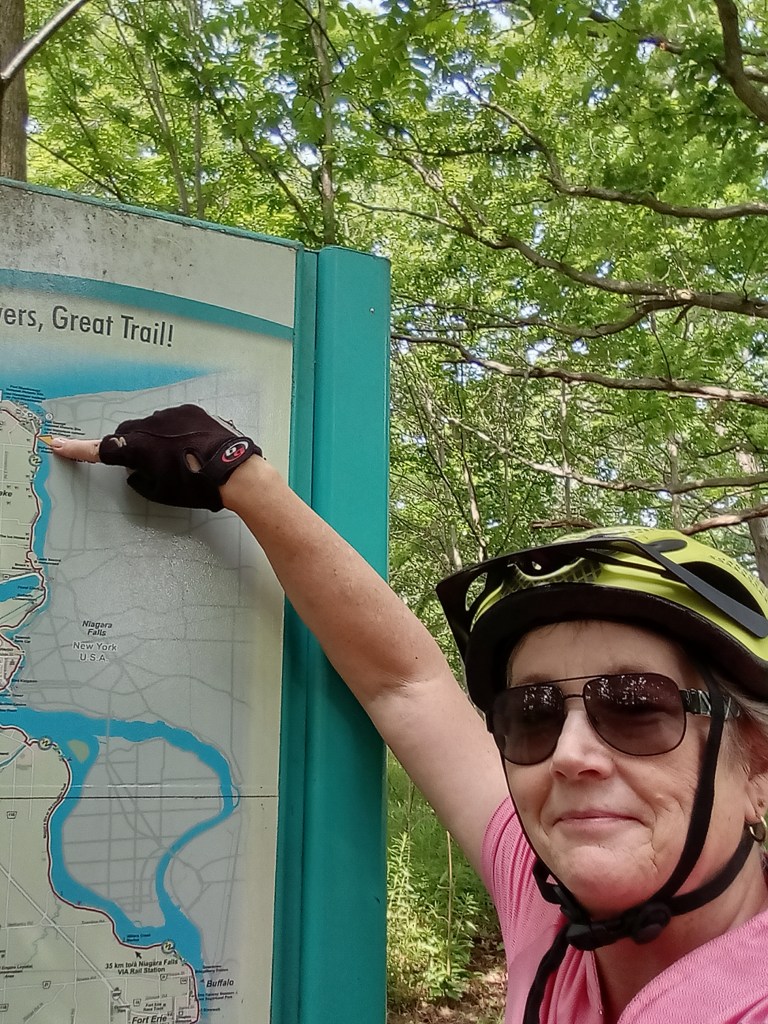
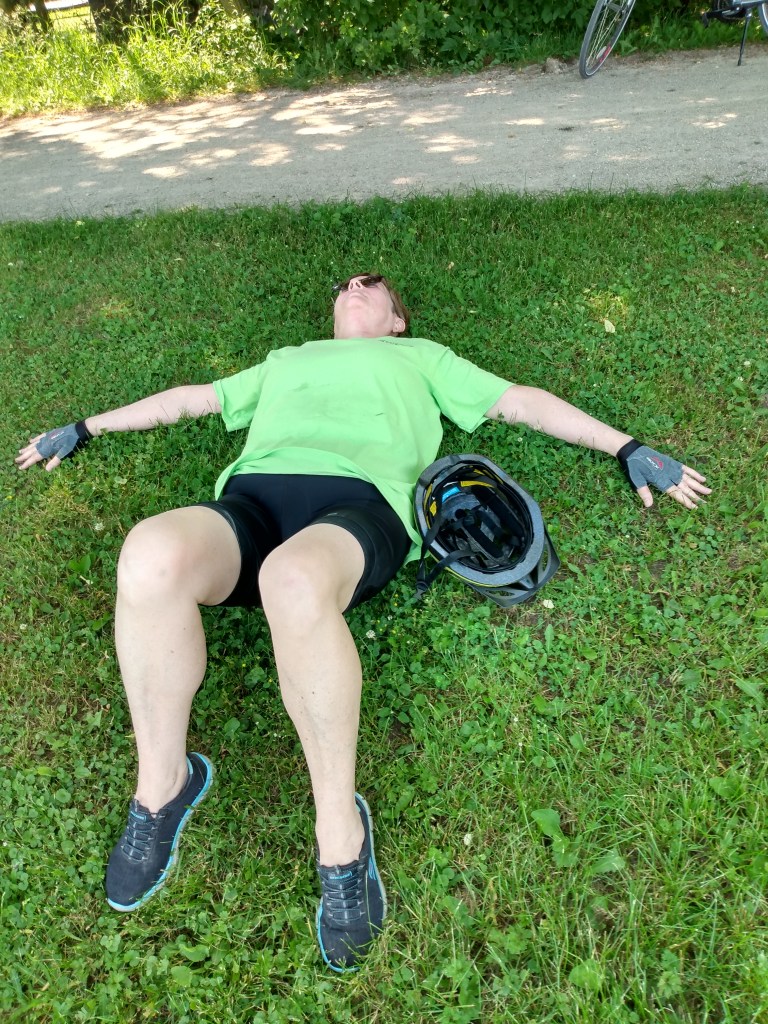
Oh, blessed autumn: cooler breezes, still-warm sunshine, and fall colours. I can’t even mourn summer when we are offered the beautiful weather that September delivered. There’s no better time for getting on the saddle and pedalling away.
Riding a bike was my primary mode of transportation when I was a kid – I travelled all over town on my gold-coloured bike. No special brakes or gears, just girl power. Now I have rediscovered bicycling as a way to visit sites all around Ontario.
My husband and I recently upgraded our 21-speed bikes for the latest craze, e-bikes. They are game changers. We can go further without wearing out and those steep hills don’t stop us anymore.
We still get exercise, but what I most appreciate about this past-time is how it gets me outdoors and enjoying nature. Bicycle paths are abundant around Ontario, and I relish the scenery as I travel through parks, over rivers and creeks on bridges, or beside farm fields on rural trails. The Guelph to Goderich Rail Trail has an added bonus of being shaded by trees planted in memory of loved ones. I see familiar names on plaques as I pass and I remember them.
Fields of hay, corn, beans, and apples reveal the seasons as we travel by them in early spring, again in mid-summer, and finally at harvest time. Then, there’s the animals. Watching a young horse, also enjoying the fresh air, chase the sheep around an enclosed pen brings a smile while seeing a beautiful red fox leap across the trail a few short yards ahead brings a gasp of wonder. The groundhog that ran across the trail and thankfully passed under my pedals brought a shreak!
It feels good to get away from the concrete and ordered life of town or city.
Bicycling is also a bit of an escape from daily chores and gives me time to reflect. As I do, the neurons in my brain seem to make new connections as they sort memories, conversations, and recent readings.
The corn stalks beside the trail eventually create a wall that towers above me, and I think about the fact I was not raised on a farm. I’m a townie. My parents didn’t even maintain a garden. Food, as far as I knew, came from the grocery store and was canned, boxed or frozen. But I loved to visit my friend who did live on a farm, and I remember her father seemed to really appreciate it when I asked to go out to the barn. (I dearly wanted to see a calf being born but was not rewarded that wish!) Even as a self-absorbed teenager, I sensed the deep devotion her father had to his farm, the care of his animals, and the tending of his crops. This usually quiet man would become animated as he told me about the farm. Farming was his livelihood, but there was a connection to his way of life that went deeper than a job.
We were never allowed to have a pet at home, but I remember making a big deal of stepping on an ant one day. My dad, always one to poke a conscience, asked me why I had done that. The ant wasn’t doing anything to me, was going about its own business, and had a right to live, he said. Geesh, make a kid feel guilty about an ant? Seemingly simple memory, but the intended lesson has stuck. (So glad I missed that groundhog, and the chipmunks!)
I recall going to school in downtown Toronto, returning home most weekends via bus. As the bus got closer to rural landscapes and I could see farm silos and barns out the window, the knots in my stomach would begin to unravel.
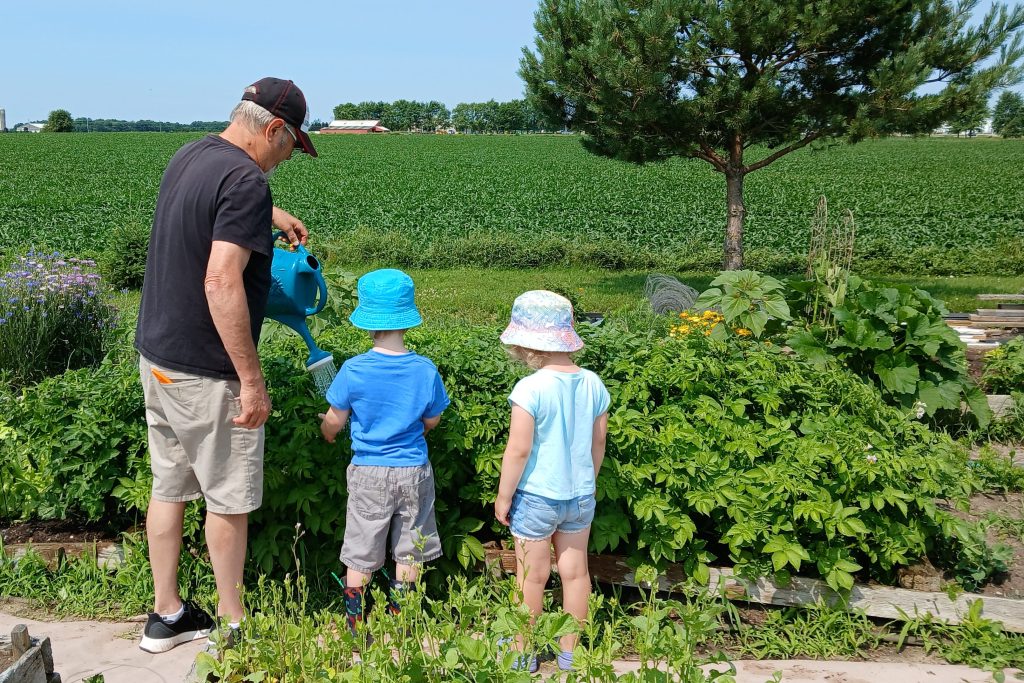
I remember that when my kids were little, we would go out on “nature” walks and I would get them to look for and collect different shaped leaves, or rocks etc. I especially loved the smell of the earth in the spring and the smell and sound of rustling leaves in the fall. Our grandchildren have also enjoyed walks through local trails, in deeply wooded areas where the ground cover of pine needles absorb sound and it is quiet. We listen and identify sounds we may hear. On one occasion, I picked up a small twig of pine needles and suggested to my young granddaughter that it was a mouse broom and perhaps they were using it to clean their homes. A bit of fanciful nonsense that we shared. A year later we visited the same area and she was telling me she had found the mouse brooms!
These seemingly unconnected memories reinforce the idea I don’t have a history of living on the land, but I do feel some kind of connection to the land, or to nature. My inside voice has always suggested this connection was perhaps a bit fake or “put-on” because, as I say, I don’t have a history that I can connect to.
Or do I?
This tenuous connection was given some veracity recently as I began to read Braiding Sweetgrass, Indigenous Wisdom, Scientific Knowledge, and the Teachings of Plants by Robin Wall Kimmerer. In her preface, she explains that sweetgrass is “the sweet-smelling hair of Mother Earth.” Then, she adds a statement that has really stuck with me: “Breathe it in and you start to remember things you didn’t know you’d forgotten.”
I contemplate a crazy thought. Is it possible my sketchy connection to the land is based on a memory I have forgotten, a memory passed to me through my ancestral roots, or even further back in time to my place in the world as a human being? If we were created to play a part in the eco-system of earth, perhaps there’s a reason beneath my appreciation of the smells and sounds in nature or behind the unravelling knots in my stomach when I see a rural landscape.
Is it possible, I continue to reflect, that we are all connected to Mother Earth, but some of us have forgotten? That it is buried by generations of progress and development that pushed the connection down deep into our subconscious?
I hear many people reflect the sentiment that we have lost touch with the land; we have moved away from living on the land, of surviving only by what the earth can give us. Our modern, urban existence has changed our relationship with the land. I wonder again, have we suppressed a connection?
I have also understood that people who farm the land, and Indigenous peoples have different relationships with the earth. But I didn’t fully understand the Indigenous connection until reading Kimmerer’s book.
In Indigenous culture, the land is a gift. And to fully appreciate this, you must also understand how the Indigenous interpret the term “gift.” Their economy is based on a gift exchange, unlike ours which is based on a commodity exchange. As Kimmerer explains, if you pay for a pair of socks in a store, the exchange ends once you give the clerk your money. You now own the socks. That’s a commodity exchange. But if those socks were given to you as a gift, the gift creates an ongoing relationship between you and the gift giver. The gift comes with responsibilities and obligations, and a need to reciprocate.
The earth is a gift from the Creator and thus, in Indigenous culture, it can’t be bought and sold as a commodity. And when we accept the gifts of the earth, we are obligated to care for them. We are to reciprocate by returning the gift.
Kimmerer asks “How in our modern world, can we find our way to understand the earth as a gift again, to make our relations with the world sacred again? I know we cannot all become hunter-gatherers – the living world could not bear our weight – but even in a market economy, can we behave “as if” the living world were a gift?”
If we believed the world was a gift, how might we change our behaviour?
I certainly feel I have been blessed with a gift as I bicycle on trails around Ontario where you get a whole new perspective of the land, and the nature that inhabits it.
As I continue reading Kimmerer’s book, I look forward to further food for thought as she weaves her first-hand knowledge of Indigenous culture as a member of the Citizen Potawatomi Nation, with her professional training as a botanist and scientist. Perhaps October will offer more opportunity for bicycling and reflecting.
***
Kimmerer, Robin Wall, Braiding Sweetgrass, Indigenous Wisdom, Scientific Knowledge, and the Teachings of Plants, Milkweed Editions, Canada, 2013.