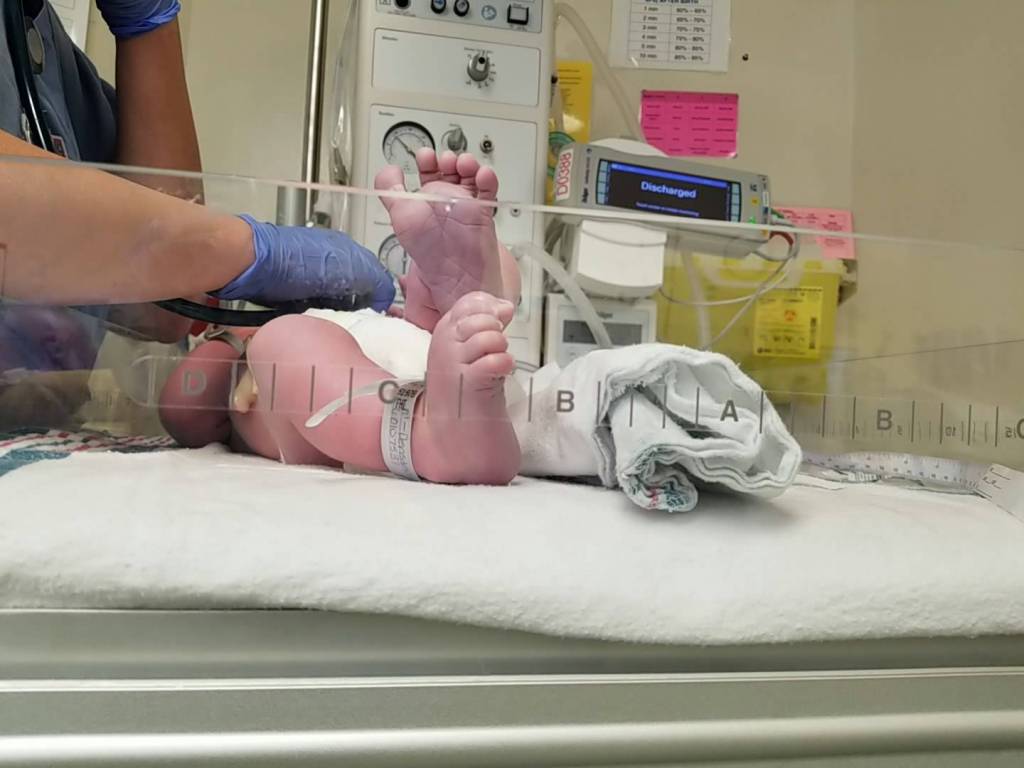
There’s a lot going on in the world right now, but I am going to use my space this month to share a perspective about an issue that impacts a very small group of people, and yet it has attracted a huge amount of negative attention based on inaccurate information and fear of the unknown.
When I was young and naive, I recall laughing at a joke that asked, how do you tell the difference between boys and girls with the answer, you look under the blanket, and the punch line: girls have pink booties and boys have blue booties.
But, like other things from the past, the joke needs to be retired because I know better today. It falls short on what it means to be human – it was never totally accurate by the way. But now people are speaking up and the rest of us are learning. I’d like to share the evolving I have done as I learned more about this topic.
My first inkling there was more to be understood came when I read in my university textbook that some people are born intersex – having both male and female traits.
About 1.7% of people are born intersex – the same frequency as people born with red hair. (How many people do you know with red hair? One, two, more? That’s how many intersex people exist in your sphere.)
Sometimes the traits are visible, and at other times the evidence isn’t known until puberty. It would take an ultrasound, for instance, to see a uterus, vagina, or testicles that have not descended.
Fast forward a few years and I hear a radio interview with a person who was born obviously intersex. The doctor made a decision at their birth to remove one set of genitals and leave the other, deciding what sex the baby would be and sending the parents home to raise them with those expectations. The child grew up feeling that their gender identification (what they believed about themselves) did not match their sex as determined by the genitals that the Doctor left intact.
I was intrigued and perplexed. It seemed there may be more to our gender identification than just our genitals – or how we are raised.
As I continued to listen with an open mind to what others were saying, I began to also understand there are some people who are not intersex, but who do not identify in any way with the biological sex they presented at birth.
That had to sit for a while. I have a curious nature – how could this be, I wondered? Our binary world of male/female or he said/she said is very ingrained because that explains the majority of us.
My childhood had been defined by the fact I had four older brothers and no sisters. I was often frustrated by what the boys could do that I could not, and I spurned things I deemed “too girly,” but I never wanted to be a boy. I knew I was a girl – my internal sense of being/my gender identity was female.
I learned it is different for others. Some girls don’t just want to do what the boys do, they believe to their very core that they are male. And some boys believe to their very core they are female. They were speaking of a misalignment between their genitals which indicated a particular biological sex at birth and the deep belief they were not that gender – had never been that gender. Their gender identity did not match their biological sex: the definition of gender dysphoria. They didn’t just suddenly feel this – it is something they had struggled with over time and didn’t necessarily understand themselves.
My initial reaction was I couldn’t imagine the agony of feeling like you are trapped in the wrong body. So I made an effort to learn more.
I confess to confusion as it seemed to throw so much of what we understand about gender, sex, and social roles into the deep end of the ocean. Suddenly, matters such as bathroom use in public spaces, team creation, change rooms, and department store arrangements are no longer benign but loaded questions.
Questions around the use of bathrooms in public spaces created a conundrum for me. How far do I go in believing or supporting this phenomenon?
So, here is what I have learned to date by reading and also attending presentations by transgender people:
At a presentation by a transman (one I had a chance to attend through my church) he addressed something I had noticed, that it seems like there’s a lot of people suddenly deciding they are mis-gendered. Is it a “trend” without real substance, as some claim?
He asked us to consider how our society used to believe left-handed people were evil, and then we evolved and learned that some of us are just born that way.
When it became safe to declare oneself as a lefty, starting in the 1900s, many people came out of that “closet.” There was a growing upward trajectory in the number of people who said they were left-handed. Then, around 1960, the number settled.
The same situation exists for gender dysphoria, he said. It will peak, and then it will settle statistically. There are more left-handed people in the world than trans, but it is the acceptance of being different which allows people to self-declare that this comparison highlights.
I still needed more information, so get ready next for a short biology lesson.
My simple understanding of biological sex taught me that XY chromosome makes a boy and XX makes a female. But that’s not the full truth. A person may have XXY, or XO, or XYY, or even XXX.
In addition, it is the SRY gene located on the Y chromosome that initiates the formation of testes triggering male anatomical structures. Its absence results in a female. However, the SRY gene can be missing or damaged or found on an X chromosome resulting in a person with XY being female and XX being male. (It is this gene that the International Olympic committee has just announced it will test for in all female athletes – and I don’t know enough about this specific subject to comment. Just that there is also political pressure involved in this issue and much more biology for us all to understand. I’ll keep listening and learning.)
According to the excerpt of an article in Science Direct, “Contrary to the belief that biological sex is strictly binary, the genetic, molecular, and cellular mechanisms that control development of sex-specific tissues and organs can and do result in outcomes that are not strictly male or female. In other words, the mechanisms at play in sex determination suggest that biological sex is not binary, but instead bimodal.”
Thus, the fact some people say they are non-binary, meaning they don’t identify as either male or female, makes sense. And there is more to being male or female than what the X or Y chromosomes may suggest.
Our gender identity, as I understand from reading multiple sources, is derived from a combination of chromosomes; hormones, including early hormonal activity in the brain during gestation; and genes, all of which interact with social influences after birth.
So is how one feels about their gender biological (nature-driven) or is it social (how we are raised)? If we throw enough pink dolls and skirts at a girl, will it make her more female? Conversely, if we toughen up the effeminate boy, will it make him more male?
PubMed Central is an archive of biomedical and life sciences journal literature at the U.S. National Institute of Health’s National Library of Medicine. A peer-reviewed article accepted for publication found on this site says: “existing empirical evidence makes it clear that there is a significant biological contribution to the development of an individual’s sexual identity and sexual orientation.” So more nature and less nurture.
People are said to transition, but the fact is they believe they have always been the gender they are transitioning to, that transitioning is simply matching their exterior to who they know they are inside. Their sexual identity.
There is more to this subject, (being transgender does not necessarily mean a person is homosexual, for instance), but it’s more than I can possibly cover in an already long blog post. And I am not a scientist, but I do trust those who have the education and qualifications to reach a deeper understanding of the human condition. This subject will continue to be studied, but I have concluded that there can in fact be a disconnect between biological sex as determined by one’s genitals and gender identity as determined by how one feels about who they are. Those feelings can come as early as age 3 or 4, based on my reading. Surgery, if it is desired, can not be performed until the person is an adult.
According to Government of Canada census data, since 2021, people have the option to qualify the sex question by choosing “at birth” and a new question about gender was added.
The 2021 census indicates of the nearly 30.5 million people in Canada, aged 15 and over, living in a private household in May of 2021, 100,815 were transgender (59,460) or non-binary (41,355) accounting for 0.33% of the population in this age group. That means 1 in 300 people in Canada is transgender or non-binary. (Likely higher given that many trans youth are kicked out of their homes by parents who don’t understand.)
Regardless, it’s a relatively small number so why should we change our jokes, our bathrooms, our pronouns – for such a small number of people? The fact that suicide among youth who experience this reality is higher than average is enough for me. But consider:
- It’s kind of like the ramps we see everywhere for those people who use a wheelchair – it doesn’t hurt everyone else to have this access available for the smaller number of us who need them.
- A bathroom stall with full walls and a door makes the toilet private and available for everyone, regardless of what’s in their pants. Handwashing isn’t a private task.
- Adding my pronouns after my name makes it easier for someone who needs to have those gender markers clarified, so I am doing something to make “the other” more comfortable and welcome.
- There’s enough about the human race that is common and can be funny without singling out a group that suffers from so much misinformation and discrimination.
Gender dysphoria is not an ideology as some suggest. It is real. Knowing about it won’t make someone transition, but it may decrease the discrimination targeting this minority group of human beings, and it might increase understanding and acceptance for what is “different” in our world.
Humans are wonderfully made and complex. Some of us are quite unique, but we all seek acceptance, and we all deserve respect, regardless of the colour of our booties. End of story.
***
NBC News, accessed March 6, 2026, https://www.nbcnews.com/news/us-news/transgender-people-texas-blocked-changing-gender-state-ids-rcna167860
Global News, accessed March 28, 2026,
Clark, Brianna, Left-handedness and the cycle of acceptance, Medium, https://brilovely.medium.com/left-handedness-and-the-cycle-of-acceptance-3e8d0386f0ef
National Library of Medicine, National Centre for Biotechnology Information, SRY: Sex determination,
Government of Canada, Statistics Canada, accessed March 4, 2026
https://www150.statcan.gc.ca/n1/daily-quotidien/220427/dq220427b-eng.htm
Science Direct, Teaching the complexities of biological sex determination with the foal of creating a more inclusive classroom and perhaps challenging key components of the oversimplified rhetoric of the gender binary, Abstract, by Rebecca Delventhal, accessed March 4, 2026
PubMed Central, National Library of Medicine, accessed March 6, 2026
https://pmc.ncbi.nlm.nih.gov/articles/PMC6677266/
I have also read two books written by trans authors and these were:
Knox, Amanda Jette, Love Lives Here, Viking, Penguin Canada, 2019
Mock, Janet, Redefining Realness, Atria, Simon and Schuster, 2014

 StillKim
What do you think?