• Pink or blue?

    Pink or blue?

    There’s a lot going on in the world right now, but I am going to use my space this month to share a perspective about an issue that impacts a very small group of people, and yet it has attracted a huge amount of negative attention based on inaccurate information and fear of the unknown. 

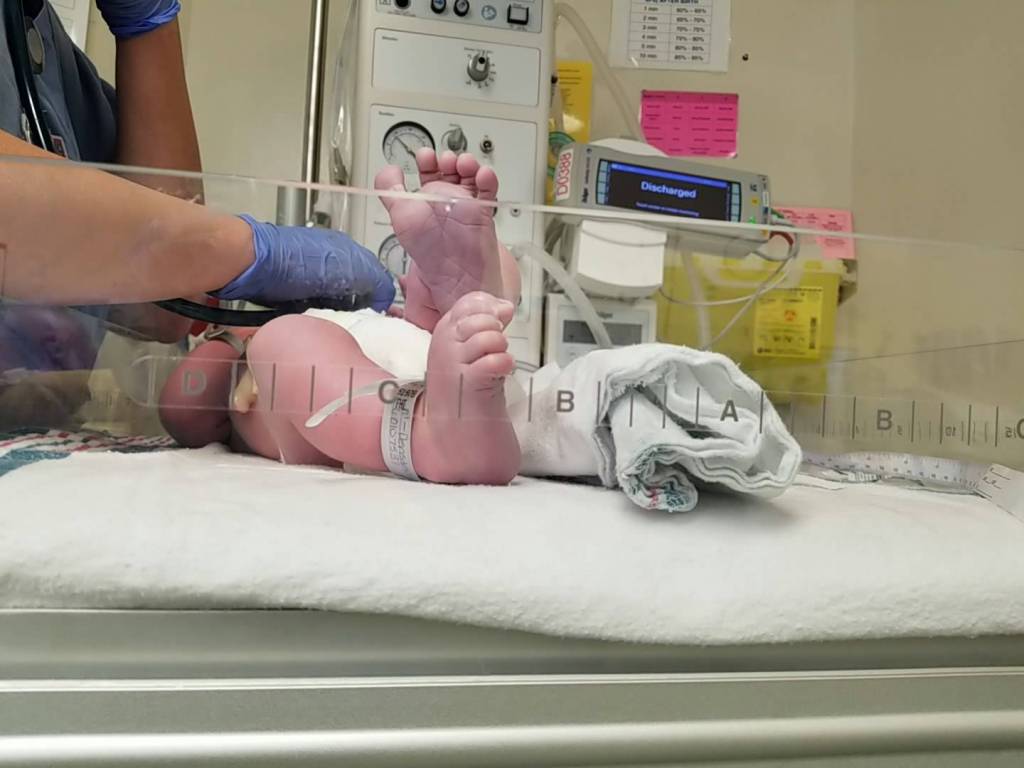
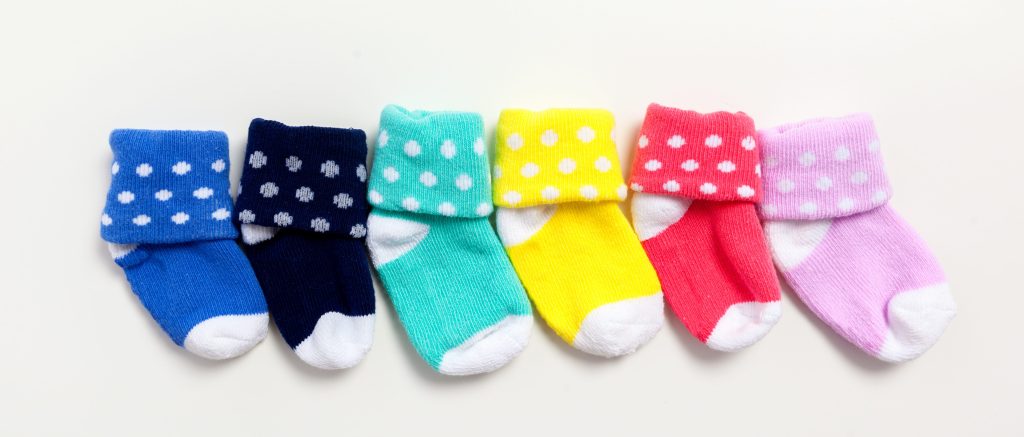
    When I was young and naive, I recall laughing at a joke that asked, how do you tell the difference between boys and girls with the answer, you look under the blanket, and the punch line: girls have pink booties and boys have blue booties. 

    But, like other things from the past, the joke needs to be retired because I know better today. It falls short on what it means to be human – it was never totally accurate by the way. But now people are speaking up and the rest of us are learning. I’d like to share the evolving I have done as I learned more about this topic.

    My first inkling there was more to be understood came when I read in my university textbook that some people are born intersex – having both male and female traits.

    About 1.7% of people are born intersex – the same frequency as people born with red hair. (How many people do you know with red hair? One, two, more? That’s how many intersex people exist in your sphere.)

    Sometimes the traits are visible, and at other times the evidence isn’t known until puberty. It would take an ultrasound, for instance, to see a uterus, vagina, or testicles that have not descended. 

    Fast forward a few years and I hear a radio interview with a person who was born obviously intersex. The doctor made a decision at their birth to remove one set of genitals and leave the other, deciding what sex the baby would be and sending the parents home to raise them with those expectations. The child grew up feeling that their gender identification (what they believed about themselves) did not match their sex as determined by the genitals that the Doctor left intact.  

    I was intrigued and perplexed. It seemed there may be more to our gender identification than just our genitals – or how we are raised. 

    As I continued to listen with an open mind to what others were saying, I began to also understand there are some people who are not intersex, but who do not identify in any way with the biological sex they presented at birth.

    That had to sit for a while. I have a curious nature – how could this be, I wondered? Our binary world of male/female or he said/she said is very ingrained because that explains the majority of us.

    My childhood had been defined by the fact I had four older brothers and no sisters. I was often frustrated by what the boys could do that I could not, and I spurned things I deemed “too girly,” but I never wanted to be a boy. I knew I was a girl – my internal sense of being/my gender identity was female.

    I learned it is different for others. Some girls don’t just want to do what the boys do, they believe to their very core that they are male.  And some boys believe to their very core they are female. They were speaking of a misalignment between their genitals which indicated a particular biological sex at birth and the deep belief they were not that gender – had never been that gender. Their gender identity did not match their biological sex: the definition of gender dysphoria. They didn’t just suddenly feel this – it is something they had struggled with over time and didn’t necessarily understand themselves.

    My initial reaction was I couldn’t imagine the agony of feeling like you are trapped in the wrong body.  So I made an effort to learn more.

    I confess to confusion as it seemed to throw so much of what we understand about gender, sex, and social roles into the deep end of the ocean.  Suddenly, matters such as bathroom use in public spaces, team creation, change rooms, and department store arrangements are no longer benign but loaded questions. 

    Questions around the use of bathrooms in public spaces created a conundrum for me. How far do I go in believing or supporting this phenomenon?

    So, here is what I have learned to date by reading and also attending presentations by transgender people:  

    At a presentation by a transman (one I had a chance to attend through my church) he addressed something I had noticed, that it seems like there’s a lot of people suddenly deciding they are mis-gendered. Is it a “trend” without real substance, as some claim?

    He asked us to consider how our society used to believe left-handed people were evil, and then we evolved and learned that some of us are just born that way.

    When it became safe to declare oneself as a lefty, starting in the 1900s, many people came out of that “closet.” There was a growing upward trajectory in the number of people who said they were left-handed. Then, around 1960, the number settled.

    The same situation exists for gender dysphoria, he said. It will peak, and then it will settle statistically. There are more left-handed people in the world than trans, but it is the acceptance of being different which allows people to self-declare that this comparison highlights.

    I still needed more information, so get ready next for a short biology lesson.

    My simple understanding of biological sex taught me that XY chromosome makes a boy and XX makes a female. But that’s not the full truth. A person may have XXY, or XO, or XYY, or even XXX.  

    In addition, it is the SRY gene located on the Y chromosome that initiates the formation of testes triggering male anatomical structures. Its absence results in a female. However, the SRY gene can be missing or damaged or found on an X chromosome resulting in a person with XY being female and XX being male.  (It is this gene that the International Olympic committee has just announced it will test for in all female athletes – and I don’t know enough about this specific subject to comment. Just that there is also political pressure involved in this issue and much more biology for us all to understand. I’ll keep listening and learning.)

    According to the excerpt of an article in Science Direct, “Contrary to the belief that biological sex is strictly binary, the genetic, molecular, and cellular mechanisms that control development of sex-specific tissues and organs can and do result in outcomes that are not strictly male or female. In other words, the mechanisms at play in sex determination suggest that biological sex is not binary, but instead bimodal.”

    Thus, the fact some people say they are non-binary, meaning they don’t identify as either male or female, makes sense. And there is more to being male or female than what the X or Y chromosomes may suggest. 

    Our gender identity, as I understand from reading multiple sources, is derived from a combination of chromosomes; hormones, including early hormonal activity in the brain during gestation; and genes, all of which interact with social influences after birth. 

    So is how one feels about their gender biological (nature-driven) or is it social (how we are raised)? If we throw enough pink dolls and skirts at a girl, will it make her more female? Conversely, if we toughen up the effeminate boy, will it make him more male?

    PubMed Central is an archive of biomedical and life sciences journal literature at the U.S. National Institute of Health’s National Library of Medicine. A peer-reviewed article accepted for publication found on this site says: “existing empirical evidence makes it clear that there is a significant biological contribution to the development of an individual’s sexual identity and sexual orientation.” So more nature and less nurture. 

    People are said to transition, but the fact is they believe they have always been the gender they are transitioning to, that transitioning is simply matching their exterior to who they know they are inside.  Their sexual identity.

    There is more to this subject, (being transgender does not necessarily mean a person is homosexual, for instance), but it’s more than I can possibly cover in an already long blog post. And I am not a scientist, but I do trust those who have the education and qualifications to reach a deeper understanding of the human condition. This subject will continue to be studied, but I have concluded that there can in fact be a disconnect between biological sex as determined by one’s genitals and gender identity as determined by how one feels about who they are. Those feelings can come as early as age 3 or 4, based on my reading. Surgery, if it is desired, can not be performed until the person is an adult. 

    According to Government of Canada census data, since 2021, people have the option to qualify the sex question by choosing “at birth” and a new question about gender was added. 

    The 2021 census indicates of the nearly 30.5 million people in Canada, aged 15 and over, living in a private household in May of 2021, 100,815 were transgender (59,460) or non-binary (41,355) accounting for 0.33% of the population in this age group. That means 1 in 300 people in Canada is transgender or non-binary. (Likely higher given that many trans youth are kicked out of their homes by parents who don’t understand.)

    Regardless, it’s a relatively small number so why should we change our jokes, our bathrooms, our pronouns – for such a small number of people? The fact that suicide among youth who experience this reality is higher than average is enough for me. But consider: 

    • It’s kind of like the ramps we see everywhere for those people who use a wheelchair – it doesn’t hurt everyone else to have this access available for the smaller number of us who need them.
    • A bathroom stall with full walls and a door makes the toilet private and available for everyone, regardless of what’s in their pants. Handwashing isn’t a private task. 
    • Adding my pronouns after my name makes it easier for someone who needs to have those gender markers clarified, so I am doing something to make “the other” more comfortable and welcome. 
    • There’s enough about the human race that is common and can be funny without singling out a group that suffers from so much misinformation and discrimination.

    Gender dysphoria is not an ideology as some suggest. It is real. Knowing about it won’t make someone transition, but it may decrease the discrimination targeting this minority group of human beings, and it might increase understanding and acceptance for what is “different” in our world. 

    Humans are wonderfully made and complex. Some of us are quite unique, but we all seek acceptance, and we all deserve respect, regardless of the colour of our booties. End of story. 

    ***

    NBC News, accessed March 6, 2026, https://www.nbcnews.com/news/us-news/transgender-people-texas-blocked-changing-gender-state-ids-rcna167860

    Global News, accessed March 28, 2026,

    Clark, Brianna, Left-handedness and the cycle of acceptance, Medium, https://brilovely.medium.com/left-handedness-and-the-cycle-of-acceptance-3e8d0386f0ef

    National Library of Medicine, National Centre for Biotechnology Information, SRY: Sex determination, 

    https://www.ncbi.nlm.nih.gov/books/NBK22246/#:~:text=The%20SRY%20(sex%2Ddetermining%20region%20Y%20gene)%20is,DNA%20in%20the%20cell%2C%20distorting%20it%20and

    Government of Canada, Statistics Canada, accessed March 4, 2026

    https://www150.statcan.gc.ca/n1/daily-quotidien/220427/dq220427b-eng.htm

    Science Direct, Teaching the complexities of biological sex determination with the foal of creating a more inclusive classroom and perhaps challenging key components of the oversimplified rhetoric of the gender binary, Abstract, by Rebecca Delventhal, accessed March 4, 2026

    https://www.sciencedirect.com/science/article/abs/pii/S0012160625002350https://www.sciencedirect.com/science/article/abs/pii/S0012160625002350

    PubMed Central, National Library of Medicine, accessed March 6, 2026

    https://pmc.ncbi.nlm.nih.gov/articles/PMC6677266/

    I have also read two books written by trans authors and these were: 

    Knox, Amanda Jette, Love Lives Here, Viking, Penguin Canada, 2019

    Mock, Janet, Redefining Realness, Atria, Simon and Schuster, 2014

  • Making a comment

    Making a comment

    One of the reasons I chose blogging as an avenue for my writing, was the fact readers could make comments. And I have really appreciated those readers who have taken the time to do so.

    However, I understand that some are having difficulties with making comments, and I have attempted to fix the problem. I have contacted WordPress and their advice, after confirming I have all of the correct options selected in the background, is as follows:

    “If you’re still running into the login loop, here are a few things to try:

    1. Clear your browser’s cache and cookies and try again
    2. Try a different browser or device
    3. Disable any browser extensions (ad blockers in particular can sometimes interfere”

    If you would like to comment, I hope the issues have not turned you away. If you would consider giving these suggestions a try and you still have trouble, I would like to hear from you. You can use the email address stillkim@rogers.com

    The lovely person at WordPress promised: “If you’re still having trouble, I’m happy to help and dig in further!” I plan to hold them to that if the problems persist!

    Thank you for your patience and your readership!

  • Your family narrative

    Your family narrative

    Have you caught the bug yet? The one where you disappear down rabbit holes searching for ancestors in your family tree? 

    It seems to become an area of intense interest once retirement provides the time – not just to research, but to reflect about the lives of those who may have impacted our own course. 

    Knowing your ancestors’ stories can have benefits that may surprise you. If one of your wishes is that your family is resilient in the face of an uncertain future, read on!

    I felt compelled to write the story of my parents’ 54-year marriage and include the background that would explain who they were and what, or who, contributed to their story.  I grew up with a lot of detail about my father’s family, thanks to his story-telling skills, but I didn’t have much to go on about my mother’s family.

    Thanks to Ancestry.ca, a global pandemic and retirement I was able to complete Beneath the Wings of Love, which I published as a paperback on Amazon in 2021. This success followed years (I started this project in 1998)of drought when there was no writing, and then significant writing and re-writing – at one point I lost the entire project in a computer crash, but thankfully I had printed out hard copies for editing. 

    I remember wishing my mother had known more about her own background as I thought it would have made a positive difference in her self-esteem. Turns out I was right on that count, and I had underestimated how important the stories would be for my grandchildren. 

    Bruce Feiler wrote in the New York Sunday Times about a study conducted by psychologists Dr. Marshall Duke and Dr. Robyn Fivush that tested the hypothesis: children who know a lot more about their families tend to do better when they face challenges. 

    “The more children knew about their family’s history, the stronger their sense of control over their lives, the higher their self-esteem and the more successfully they believed their families functioned,” Feiler wrote of the study’s findings. 

    Then 9-11 happened, and although the families were not directly impacted by the horrific events of that day, the children in the study would have been impacted by news of planes hitting the towers.  They were reassessed. Feiler quotes Dr. Duke, “the ones who knew more about their families proved to be more resilient, meaning they could moderate the effects of stress.”

    Why? According to Dr. Duke, these children have a strong sense of an “intergenerational self” and know they belong to something bigger than themselves. Things like family traditions, family holidays, telling stories about the family, whether hardships met or positive tales, all contribute to a strong family narrative. 

    You don’t have to publish a book to contribute to the family narrative, but safe-keeping what you know in some format is clearly beneficial. If your children or grandchildren are not asking questions yet, we know there will come a time when they will wonder. So, take up a pen, or get on your computer and type what you know – now.  At the very least, store the pages in a three-ring binder. Talk to relatives still living to get their stories and write them down, and add to the binder!

    If you have adoption in your story, don’t avoid this. A family tree can be a tree of people who love me and the stories still contribute to the narrative of what your child knows about the family they call their own. 

    Sometimes the family history contributes to the history of the commercial development of an area. Such was the case when a former schoolmate of mine, Lynn Thorne and her cousin, Evanne Ketchabaw got together and created a road trip out of their shared Zurbrigg family history. The trip took family members, in their cars, through villages, along county roads, and by specific sites surrounding the Listowel (North Perth) area where four Zurbrigg siblings had moved in the early 1860s.

    The family had many entrepreneurs so stops along the way highlighted the businesses as well as the homes and final resting places of multiple ancestors. The cousins wrote a script to accompany the journey so at specific stops, the history was read out loud for the 15 participants. After the event, everyone received a booklet, bound in a clear plastic cover; family details shared during the road trip were included along with photos from the day. 

    What an amazing, interactive way to share the family narrative. 

    Other family histories are relevant beyond the family because they are a history of national importance. Such is the case for Tracy Lee Johnson of Guelph. 

    I attended a fascinating presentation by Tracy, a 5th generation Black Canadian, who shared an historical look at an area called Queen’s Bush, one of the largest Black settlements in the area, near Wallenstein. Her ancestors travelled to the area in the 1830s via the underground railway and were early pioneers before this nation was even created. The year 1806 is the earliest date for which she has found a record of her family in the Niagara area.  

    Tracy’s story reinforces what the psychologists’ study showed. “Had I known the information about my family when I was younger, I would have held my head up higher. I would not have felt so uncomfortable in my own skin,” she told me.

    There was reason for pride in her ancestors’ early contributions, yet our history books have largely ignored their story. When we think of pioneers, we tend to think white, and Little House on the Prairie, Tracy points out. She’s right. 

    As well as effective story-telling (Tracy is an actress), she also sings as part of her presentation. She presents in schools, helping to educate the broader community about Black history in this area. In fact, you can book Tracy, through her website, to share her amazing historical story with your group, club or organization.

    If, like me or Tracy, you don’t know a lot about your background, tools such as Ancestry.ca help.  This program allows you to build a family tree and each name on the tree links to a page of details where you can fill in the names of parents, siblings, and children. Links to census details and old newspapers are revealing. I was able to discover causes of death, adding detail not known before, and pointing to a possible inherited trait. I was finally able to fill in the blanks about my mother’s history. Even the painful knowledge of early ancestors who farmed on native land in the U.S. and had deadly run-ins with Native Americans (Shawnee) in the area. 

    As I worked on the memoir, I was not unaware of the privilege I enjoyed in being able to conduct this research. Especially as I uncovered these earliest settler stories, I brought 21st century eyes to the issue of European settlers believing they were bringing civilization to savages, ignoring the multiple generations of history lived by these Indigenous people. I thought of Indigenous children who were stolen from their parents by the Canadian government and then turned out of residential schools at age 18 with no understanding of how to cope on their own. They didn’t fit with their own community any longer, unable to speak the language and with no knowledge of their customs. They had no family history. And they were spurned by the predominately white settler community they lived in. They had both their past and their future stolen from them.  The studies that connect resilience, happiness, and self-esteem to knowing your family narrative reinforce the horror of what was done and explain the generational damage that has resulted.

    We must evolve as we learn, and then share our knowledge. So, if you are down a rabbit hole of family research, or if you have stories stored in your memory, start making notes to be shared. Share the good, the bad and the ugly. You will be doing your grandchildren and great-grandchildren a huge favour when they know the intergenerational narrative that is theirs to claim.

    ***

    Bruce Feiler, The Stories that Bind Us, New York Times, March, 2013 http://www.nytimes.com/2013/03/17/fashion/the-family-stories-that-bind-us-this-life.html?pagewanted=all&_r=0

    Tracy Lee Johnson, Website, https://tracylcain.wordpress.com

    Tracy Johnson shared a newsletter that “honours the creativity, scholarship, and dreams of Black mamas, women and girls in Canada.” Tracy’s story is featured in the November 2025 issue. Check it out here: https://www.animawrites.com/newsletter

    Beneath the Wings of Love, the memoir of my parents, is available on Amazon. If you are interested in the process of self-publishing, please connect with me. Beneath the Wings of Love is written under my pen name, Roberta Kim. 

  • Planning the perfect exit

    Planning the perfect exit

    On the heels of my Still Inspiring story featuring Grace Maher, Funeral Director extraordinaire (January 2026 post), I have had some conversations recently with friends about that supposedly taboo subject – planning for our final exit from this world. 

    We all lamented the situation that Grace referenced during my chat with her, that some people are not holding any kind of service or celebration of life after a loved one has died. (There, I said the “D” word, not some light hearted euphemism) 

    I read many obituaries (yes, I am at that age!) that report no service or visitation is being held “in accordance with the wishes of the deceased.” 

    Really? Come on! 

    The funeral isn’t held for the deceased. It’s held for the living. 

    Why would you want to rob your family or friends at least some time to remember what a cantankerous or miserable old, er,,, I mean loving person you were while you walked the earth? ;)

    At the very least, your directions should be designed to keep the family busy at something other than arguing about how little you left in the will. Enough time for that later!

    And then there’s the black humour that we are robbing our family of experiencing when they have to follow our wishes. 

    One friend shared a story about being in “that” room of caskets at the funeral home. “I like to go shopping, but this isn’t really what I had in mind,” she blurted out loud as she was still trying to take in her father’s sudden and unexpected death.

    I guess if you shop til you drop, you’re in the right place?

    If there’s proof that the funeral is for the living and not the deceased, consider my family’s experience in that department store of caskets after my beloved father’s death. My brother and I honed in on the plain pine box without brass handles or fancy decorations and looked at each other. “This is exactly what dad would want,” we said at the same time. And then in the next breath, “But what would people think?” 

    So we purchased the next best option, preserving the family reputation. (Although I did sing, under my breath, the words to Tight as a Drum during the service – as Dad had requested. He’d also wanted the ashes flushed (yup!) but since, as I say, the funeral is for the living, we didn’t do that. And since singing the slightly ribald war tune out loud might have shocked the still-living assembly, I kept it very low, but I am sure Dad was laughing.)

    As strange as it seems, doing the things I knew he would want gave me comfort at a time I needed it. (Did he, in his wisdom, realize that?)

    Without specific direction from my mother when it was her turn, we would never have known that she wanted a grey casket. So it would match the rose-coloured dress she chose as her “going away” outfit. (I kid you, not) I mean, who knew they came in colour options? Caskets, I mean, not going away dresses! She loved grey – thought it was classy!

    I’m sure people would have talked for months without that colour co-ordination. We even made sure the flowers would complement the colour scheme. 

    A friend shared a story about a favoured relative who, in life, always had her slip showing below her skirt hem. Many of the women at the funeral wore their slips just a little bit lower than required in her honour. If there had been no service, how would they have been able to honour her in this unique way?

    I love the old movie “Imitation of Life,” the one made in 1959 starring Lana Turner. It’s a real tear-jerker at the end when the funeral for Annie Johnson (played by Juanita Moore) is featured, just as the Black housekeeper outlined in her funeral plans. Those plans included a large church, a gospel choir, a funeral procession with a band and four white horses drawing the hearse. She really knew how to go out in style. And it did the trick, but you will have to watch the movie to learn what it did for her daughter. No spoiler alerts here. (But if you’re a Mahalia Jackson fan, she gets a cameo role!)

    The point is, the housekeeper had a plan for when the inevitable happened. Smart woman. 

    How many times have you attended or arranged a funeral and learned something you didn’t know about the deceased? 

    I didn’t know my friend sang the Lord’s Prayer while out fishing on a lake one early morning with only one person, and we imagine a host of God’s creatures, to hear him. What a great remembrance I now have of him. 

    Someone told me about a kindness my mother had extended to neighbours when they needed it most, and I never knew about it. Now a treasured memory I have of her. 

    How often have you said ”I didn’t know that!” after a funeral? And as a result, that person’s time here is extended because you have that memory. 

    That was Grace’s point. We miss out on those stories if we don’t hold something

    I’m not here to sell funeral home or church services, but only to stir some thinking in how you might be approaching this subject. (Not to be morbid, but we all have an exit date!)

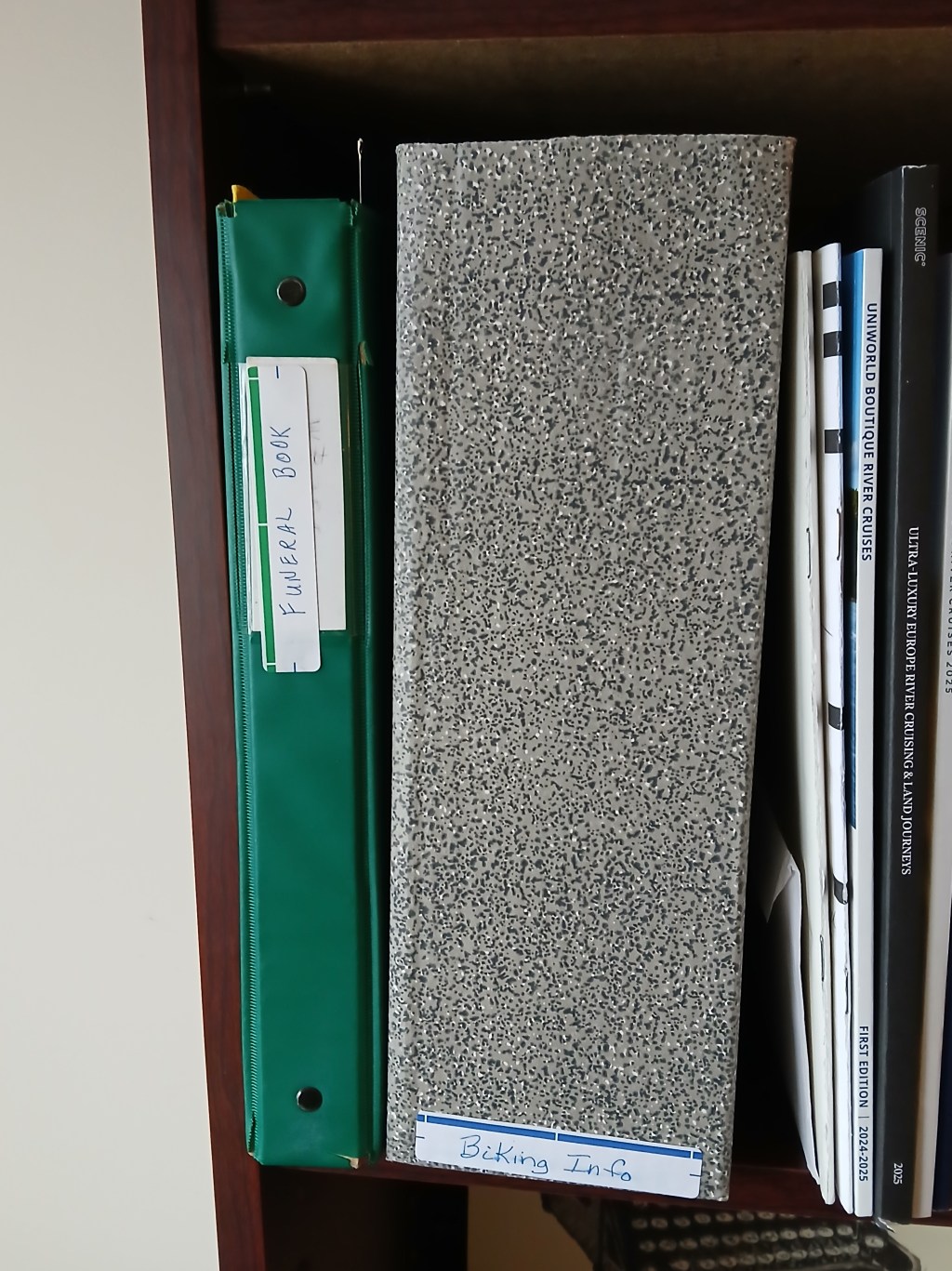
    I have created a funeral binder (thanks Marg for the advice on this!) and told my kids where to find it. It includes all of the documents they will require at the time, as well as some advice and suggestions for the “arrangements” as we call them.  I have seen something similar online with the title “F*&$ I’m Dead. Now What?” but you can create your own version and spend less! Just borrow the fancy name and give the kids a giggle after you are gone!

    There’s lots of online advice about what should or can be included, such as marriage certificate, birth certificate, will, insurance papers, banking instructions, burial plot or directions for ashes, music preferences, speaker preferences, – even the colour of your casket if that’s important to you! (Or as one movie recently depicted, the father requested that his sons actually dig the grave – yikes!)

    I have avoided a post on new year resolutions because they just get hijacked anyway, but perhaps this is something you would consider doing this year for your family. They will benefit from the directions.

    But, tongue firmly planted in cheek, why not leave them directions they’ll talk about for years to come?! 

    ***

    If you have a unique funeral story to share that demonstrates the importance of this ritual in our lives, please share by replying to this post. Scroll down to the bottom of the page to find the comment field. I suspect our stories will uplift each other! 

    Some readers have told me they have difficulties when trying to comment on a post.  I have been told that you should be able to leave a reply after typing in the comment field and clicking on PostComment. You will be asked for your name and email only. You do not require an account to make a comment (if you have a WordPress account, then it may kick in to ask you for those details. One of my readers, unbeknownst to her, did have an account. If this happens, try another email account to respond under.)

  • Still Inspiring: Grace Maher

    Still Inspiring: Grace Maher

    Happy New Year dear readers!  I hope you are looking toward 2026 with a sense of hope and purpose. 

    I came across a sentiment recently that reminded me to remain positive in the face of a world that feels overwhelmingly negative right now: Don’t let your inability to do everything stop you from doing something. We can all put something positive out into the world to make it a better place for others.

    We start the new year with a focus on a woman who is definitely doing her part to help others at a time when they may be feeling especially disheartened, And, she is still making an impact, past the age when society generally deems us to be contributors.

    Have you felt lately that you are past your due date? Has a recent disruption in your life changed your course? I heard recently that we are not late for anything – it’s a thought I will reflect on more in a future post. For now, enjoy Grace’s unique path. 

    Grace Maher is diminutive in stature but her love of community is expansive, based on the special relationships she develops with families at what can be a very profound and difficult time in their lives. 

    And at 77, she has no plans of retiring from the job that for her, is a calling. “Every night as I go to sleep, I think, thank goodness I can get up and go to work in the morning.”

    As a Funeral Director, Grace walks with husbands, wives, sons, daughters, mothers, fathers, and extended family members as they navigate the decisions following the death of a loved one. And she has done so with countless families from the Elmira area over the past 56 years!

    It’s no wonder she has been honoured with a Lifetime Achievement Award from the Ontario Funeral Service Association. True to her introverted nature, I only learned of this award after contacting Laura Riley and Rebecca Steckly, owners of Dreisinger’s Funeral Home where Grace works. They had this to say about Grace: 

    “She is truly the heart of the funeral home, and her warmth and kindness radiates through to our staff, the families we care for, and to the community at large. We feel so blessed to have her as a mentor and leader to our team.”

    Grace is the fourth generation of her family to work in the funeral business, in the same funeral home that bears her great-grandfather’s name. (Her sister Marion Roes has published a book on the history of the local funeral industry: Death as Life’s Work: Waterloo Region Undertakers and Funeral Businesses. It’s available at local libraries or from Marion at mlroes@sympatico.ca)

    Their great-grandfather Chris Dreisinger purchased the business in 1905; he was followed into business by his son George and eventually turned the company over to his granddaughter Hazel Brown and grandson David Dreisinger. Hazel’s daughter, Grace, and David’s son, John, eventually entered the profession. 

    That’s the nuts and bolts of the family history, but like any historical recounting, there’s the story behind the details. 

    Grace recalls sitting on Grandma Dreisinger’s front porch and watching the funeral procession of cars on their way to the cemetery. “We would count the cars and I would watch my uncle leading the procession. I would think my mom and uncle had one special job.”

    There was never any fear associated with the work her mother and uncle did. Instead, Grace was impacted by the way they spoke to the people who came to them recalling that when the phone rang in the house, she knew to remain quiet in case it was a death call. 

    Grace wanted to create the same connection with her community that she admired in her mother and uncle. Based on her astute memory for peoples’ names and her unflappable presence during a visitation, Grace has no doubt created her own unique niche in the family’s local history.

    Current owners Laura and Rebecca emphasize Grace’s skills in their comments. “Grace has a natural ability to connect with people. She gives you her complete attention and is a wonderful listener; you walk away feeling truly seen and heard.” 

    Grace’s mother, Hazel Brown, was a strong role model  – at a time when it wasn’t common for a mother to be working, much less in a business that would be viewed by others as at least outside the ordinary or possibly even with fears born of the unknown. 

    But Grace knew she wanted to do the same work as her mother, “and she couldn’t talk me out of it.” And like her mother, Grace went on to manage the tri-factor of career, marriage and motherhood. She and her husband Skip had two children. 

    I asked Grace if it is difficult when the death is someone that she knows as a friend, but she says that knowing the deceased helps. “It’s an honour, a wonderful opportunity to be given to be with the family when they have lost someone important.”

    Grace began working at the funeral home in 1966 right out of high school, beginning the two-year Humber College course in 1967; you had to be 21 to be licensed which she was old enough to receive in 1969. Every year since, Grace has renewed her license which requires proof of continued education, many courses now offered online through the Ontario Funeral Service Association. 

    Technology has changed the funeral service and the skills a director requires. It became especially important when the global pandemic hit in 2020 to be able to live-stream services, and Grace notes, “we will never go back.”

    There have been other changes over the years. There’s more cremations today and people are more willing to discuss and even ask for help with grief. The industry has responded to society’s needs, and Grace’s own connection with families over the years, and her own experience, has resulted in a better understanding of what a family goes through when grieving. Grace has experienced her own losses over the years, most recently and significantly her husband Skip in 2025, and her son Bryan (B.J.) in a motor vehicle accident at age 27 in 2017.

    There are many decisions required when someone dies, but Grace notes that one of the changes she has seen lately is when people forgo holding either visitation or a service. 

    “We lose something when nothing is held.” Grace speaks of the grieving process and how the stories that are shared at a visitation can make a difference. She is aware of many times when visitors took time to tell the grieving family how the deceased was important to them – and how often these stories were previously unknown to the family. The stories bring comfort to the family, that their loved one will be remembered. 

    Grace exudes a calm and cheerful countenance. “It’s great to be alive,” she says in response to a question about how a lifetime of working in the death business has impacted her perspective on life.  “I’m just so grateful I live in this community and am part of this community.”

    I suspect there’s many in the community of Elmira who will be grateful in return and who will remember her kind support at a vulnerable time in their lives. Mom Hazel and Uncle David would also be proud. 

  • Is Windigo in your life?

    Is Windigo in your life?

    Ever feel like no matter what you’ve got, someone’s got more?

    So asked the bank commercial that played frequently throughout the World Series. 

    And then there’s someone with more more. 

    Is there more more? Or, is there a limit? 

    The bank says we’re richer than we think. I wonder if we really know that?

    As I unpack for the Christmas season of 2025, I am trying to sort multiple messages that are dancing in my head – not sugar plums this year. Bear with me as I sift through a few musings. Perhaps you will share these, or maybe it will be food for thought. 

    The Blue Jays theme was “I want it all and I want it now,” and this year’s series seemed to carry a special significance given the state of the world. I recall thinking at one point, Canada really needs this win.

    Of course, we know the outcome and all of the comments designed to rationalize the blow, but maybe there was a deeper, more meaningful take-away. The team’s hard work brought Canadians together at a time national camaraderie is sorely needed, but there’s more to it than that..

    Then, in another celebrity moment, I was wowed with the statement by American singer Billie Eilish at the Wall Street Journal Innovator Awards ceremony in New York city. 

    “There’s a few people in this room who have a lot more money than me,” she teased in a sing-song voice. Then, “If you’re a billionaire…why are you a billionaire? Give your money away shorties.” 

    This young (she’s only 23) singer recently donated about 22% of her net worth to support food security and climate change  – her donation was $11.5 million! Her audience was comprised of a few billionaires, including Facebook CEO Mark Zuckerberg.  (Who reportedly did not applaud the speech.)

    I wonder how many of them enjoyed a good sleep after that searing comment?  My fear is that they slept well. 

    While it’s great theatre to see wealthy people call each other out to do more, we don’t need to be a billionaire to fall victim to greed. 

    In Robin Wall Kimmerer’s  book, Braiding Sweetgrass Indigenous Wisdom, Scientific Knowledge, and the Teachings of Plants, the author describes the Indigenous monster Windigo. The short explanation is that Windigo is greed and over-consumption personified in a monster. He would be used as a threat particularly during times of hunger and great need, to keep people in check. When they might be tempted to act inappropriately. For Indigenous ancestors, that might be a winter where food was scarce.  When one might be tempted to not share.

    We can see Windigo, the monster of greed and over-consumption, in our world today. Perhaps it’s the threat of recession for us, or a world that is changing so fast we cling to false prophets.

    When the bank commercial asks us if we notice someone else who has more, that’s Windigo at work. When we envy our neighbour’s car, or house or pool that’s Windigo at work. When we purchase more than we need, that’s Windigo at work. The “I’ve too many to count boots and coats in my closet” is Windigo at work. 

    When children are starving while the rich party at their palatial estates, that’s Windigo at work. 

    When the comfortable question the support given to those with less, that’s Windigo at work.

    We should all fear this monster.

    I have always thought it was good when a business succeeds. I owned a small business for a few years, and it was satisfying to know I was generating revenue to cover incomes for at least four other people and not just myself. 

    But knowledge and time have opened my eyes to the negative repercussions of our economic system. Capitalism rewards business growth and with Windigo at the helm, we have supported a model of greed and over-consumption that has richly benefitted those at the very top echelon. Tesla just approved a $1 trillion pay package for Elon Musk and the crowd at the annual meeting burst into applause. Windigo on their shoulders.

    And the distance between the haves and have nots grows. 

    In recent news, grocery stores are now looking at digital pricing so they can immediately lower or increase the amount we pay for our groceries based on the principle of scarcity. Advertise a special, people flock to the store, and suddenly the price goes up because the demand is high. I don’t detect any sympathy in the grocery sector to suggest it won’t be used as a tool to increase their take. Where’s the concern about grocery profits?

    How do we defeat Windigo? As Kimmerer writes, we need more than a change in policy that ensures the wealthiest don’t take advantage. “It is not just changes in policies that we need, but also changes to the heart.”

    Kimmerer writes of early Indigenous teachings which emphasized the practice of taking no more than you need and always leaving some behind for others, whether that was another human, or in some cases, animal brothers and sisters. You didn’t chop down the first tree you come to and you would never chop down the last tree in the grove. Further, when you took from the earth or an animal’s life to feed your family, you gave thanks.

    You didn’t feel entitled, and your worth was not measured in possessions. And you were grateful.

    My settler ancestors certainly knew how to live frugally; they reused and didn’t buy new because they could not afford it.  But over the years in our quest to improve our standard of living, we have given way to Windigo. 

    Having more is how we have placed value on our lives. (You know the adage, the difference between men and boys is the size of their toys, designed to make us laugh as we accumulated more?)

    I remember my mother calling out this unending loop of behaviour – marketing tells us we “need” more, workers want more income to support those “needs”, business wants more for its products and services, workers want more pay, business wants…and so on. Where does it end?

    Can we fight Windigo on a personal level? 

    Kimmerer writes, “Scarcity and plenty are as much qualities of the mind and spirit as they are of the economy.” She goes on to say that a life of gratitude can be “a powerful antidote to Windigo psychosis.”

    Which brings me back to Christmas. A time of giving and of gratitude. The season that celebrates the birth of Jesus Christ who told us, among other things, we will either love God and hate money or love money and hate God. Why? Jesus would know people required money to live in the world’s economy. As Brian D. McLaren writes in his book Life After Doom, the Roman civilization in Jesus’ time oppressed the poor because “Money is the measure of value. Without money, to the empire, you’re nothing.” Those without, those with less, were considered unworthy.

    Sound familiar?

    The alternative offered by Jesus was to “run on a different currency altogether: love.”

    McLaren encourages us to read the Bible as Indigenous wisdom and to see Jesus as an Indigenous prophet, who came into the world to teach us to love one another. Part of loving another is ensuring they have enough and then expressing gratitude to Jesus, to God, to our Creator, that our needs have been met and that there is enough for everyone. We’ve lost the Indigenous knowledge of how the earth really does provide all we need, if we just take care of it.

    With all due respect to the Blue Jays, and the band Queen who made the song famous, maybe having it all isn’t what we need in more ways than one.

    ***

    Bank of Nova Scotia, YouTube, You’re richer than you think https://www.youtube.com/watch?v=C_j2FF8u_0I f, ret.November 6, 2025

    You Tube, I want it all, https://www.youtube.com/shorts/JtGdEB1fPXo, November 24, 2025

    ETalk, YouTube, Billie Eilish calls out billionaires during innovator awards speech, https://www.youtube.com/watch?v=xj2R_LuCLoU ret. November 6, 2025

    Kimmerer, Robin Wall, Braiding Sweetgrass, Indigenous Wisdom, Scientific Knowledge, and the Teachings of Plants, Milkweed Editions, Canada, 2013.

    CNN, ov, 6, 2025, Tesla shareholders approve $1 trillion pay package. for Musk, https://www.cnn.com/2025/11/06/business/musk-trillion-dollar-pay-package-vote, ret.November 24, 2025

    City News, Toronto, Shoppers are wary of digital shelf labels, but a study found they don’t lead to price surges, https://toronto.citynews.ca/2025/06/09/shoppers-are-wary-of-digital-shelf-labels-but-a-study-found-they-dont-lead-to-price-surges/ , ret. November 9, 2025

    Loblaw Companies Ltd., Media Release Nov. 12, 2025, Loblaw Reports Revenue Growth of 4.6% in the Third Quarter, https://www.loblaw.ca/en/loblaw-reports-revenue-growth-of-4-6-in-the-third-quarter/https://www.loblaw.ca/en/loblaw-reports-revenue-growth-of-4-6-in-the-third-quarter/, ret. November 18, 2025

    CNN Business, Tesla shareholders approve Elon Musk’s $1trillion pay package, https://www.cnn.com/2025/11/06/business/musk-trillion-dollar-pay-package-vote, ret. November 11, 2025

    Brian D. McLaren, Life After Doom, Wisdom and Courage for a World Falling Apart, St. Martin’s Publishing Group, New York, 2024

  • Redecorating Dorothy!

    Redecorating Dorothy!

    This month, my mother-in-law turns 95. 

    Last month we were shopping to find her a pair of jeans with sparkles on the pockets for her to wear to the weekly seniors’ dances held in her community. 

    I wish I could bottle what she has! She is active, still drives, and keeps up with all family activities. She hasn’t always had the easiest life, and I am in awe of her tenacity. 

    A few years ago, when she was just 92, I was one of four – her daughter and three daughters-in-law, along with her sons chiming in, who helped her redecorate her home. 

    And if your sympathy on reading that sentence lies with my mother-in-law, you would be correct. Yet, she weathered us with a composure I can only admire. 

    As we all popped in to see the progress after new carpet and painting were completed, she heard the various voices chime in: 

    “Now you should…

    • put those pictures on this wall
    • change that table
    • install a new light
    • move this chair there
    • take that photo down 
    • hide this blanket 
    • buy a new one…” etc. 

    You get the idea!

    This is a woman who spent a 70+year marriage doing only what her beloved husband desired. Meals reflected his tastes, holidays were spent to please him, and household purchases were dictated primarily by his tastes and budget priorities. Doing what pleased Ivan is how Dorothy happily lived her life.

    Not that he wasn’t a generous man when it came to his wife. I still recall the Christmas close to their 25th wedding anniversary when she opened his gift to discover a new diamond ring and the emotional outpouring of her love in response. Usually there was a beautiful new outfit in her Christmas box that he would have taken time to select from a local lady’s wear shop. 

    I didn’t realize her tastes may have run in a different direction until after he passed away and she began cooking and ordering food that he never wanted. And then came the renovations, encouraged by her daughter, to update her two-bedroom senior’s unit. Soft grey walls, white trim and a grey carpet followed the installation of a new kitchen counter and backsplash. All elements complemented the modern, refreshing colour scheme. 

    The decorating instincts of all the women in the family kicked into high gear. New arrangements for family photos on some walls paved the way for new prints to provide a focus on other walls. Now she relaxes in her easy chair looking at a winter scene of an old shed nestled in the middle of towering evergreens. From her table, she can imagine sitting on the end of a dock with her feet cooling in blue lake water. Bedroom prints in soft blues and greys connect to new throw pillows on the bed and new towels in the ensuite. 

    But a close second to living her life for Ivan was doing what she believed would make her children happiest. When one son said “this” and another son said “that,” what’s a woman to do? 

    She smiled her way through it all, and frankly, I don’t think we’ll ever know if the final result is what she truly wants, or reflects a choice to make someone else happy. 

    But my mother-in-law is a wise woman. She has perfected that secret to a happy life by knowing: Happiness isn’t getting what you want, it’s wanting what you’ve got. 

    I humbly confess, it’s a lesson I still work at achieving!

  • A forgotten connection?

    A forgotten connection?

    Oh, blessed autumn: cooler breezes, still-warm sunshine, and fall colours. I can’t even mourn summer when we are offered the beautiful weather that September delivered. There’s no better time for getting on the saddle and pedalling away. 

    Riding a bike was my primary mode of transportation when I was a kid – I travelled all over town on my gold-coloured bike. No special brakes or gears, just girl power. Now I have rediscovered bicycling as a way to visit sites all around Ontario.

    My husband and I recently upgraded our 21-speed bikes for the latest craze, e-bikes. They are game changers. We can go further without wearing out and those steep hills don’t stop us anymore. 

    We still get exercise, but what I most appreciate about this past-time is how it gets me outdoors and enjoying nature. Bicycle paths are abundant around Ontario, and I relish the scenery as I travel through parks, over rivers and creeks on bridges, or beside farm fields on rural trails. The Guelph to Goderich Rail Trail has an added bonus of being shaded by trees planted in memory of loved ones. I see familiar names on plaques as I pass and I remember them. 

    Fields of hay, corn, beans, and apples reveal the seasons as we travel by them in early spring, again in mid-summer, and finally at harvest time. Then, there’s the animals. Watching a young horse, also enjoying the fresh air, chase the sheep around an enclosed pen brings a smile while seeing a beautiful red fox leap across the trail a few short yards ahead brings a gasp of wonder. The groundhog that ran across the trail and thankfully passed under my pedals brought a shreak! 

    It feels good to get away from the concrete and ordered life of town or city. 

    Bicycling is also a bit of an escape from daily chores and gives me time to reflect. As I do, the neurons in my brain seem to make new connections as they sort memories, conversations, and recent readings. 

    The corn stalks beside the trail eventually create a wall that towers above me, and I think about the fact I was not raised on a farm. I’m a townie. My parents didn’t even maintain a garden. Food, as far as I knew, came from the grocery store and was canned, boxed or frozen. But I loved to visit my friend who did live on a farm, and I remember her father seemed to really appreciate it when I asked to go out to the barn. (I dearly wanted to see a calf being born but was not rewarded that wish!) Even as a self-absorbed teenager, I sensed the deep devotion her father had to his farm, the care of his animals, and the tending of his crops. This usually quiet man would become animated as he told me about the farm. Farming was his livelihood, but there was a connection to his way of life that went deeper than a job. 

    We were never allowed to have a pet at home, but I remember making a big deal of stepping on an ant one day. My dad, always one to poke a conscience, asked me why I had done that. The ant wasn’t doing anything to me, was going about its own business, and had a right to live, he said. Geesh, make a kid feel guilty about an ant? Seemingly simple memory, but the intended lesson has stuck. (So glad I missed that groundhog, and the chipmunks!)

    I recall going to school in downtown Toronto, returning home most weekends via bus. As the bus got closer to rural landscapes and I could see farm silos and barns out the window, the knots in my stomach would begin to unravel. 

    I remember that when my kids were little, we would go out on “nature” walks and I would get them to look for and collect different shaped leaves, or rocks etc. I especially loved the smell of the earth in the spring and the smell and sound of rustling leaves in the fall. Our grandchildren have also enjoyed walks through local trails, in deeply wooded areas where the ground cover of pine needles absorb sound and it is quiet. We listen and identify sounds we may hear. On one occasion, I picked up a small twig of pine needles and suggested to my young granddaughter that it was a mouse broom and perhaps they were using it to clean their homes. A bit of fanciful nonsense that we shared. A year later we visited the same area and she was telling me she had found the mouse brooms! 

    These seemingly unconnected memories reinforce the idea I don’t have a history of living on the land, but I do feel some kind of connection to the land, or to nature. My inside voice has always suggested this connection was perhaps a bit fake or “put-on” because, as I say, I don’t have a history that I can connect to.

    Or do I?

    This tenuous connection was given some veracity recently as I began to read Braiding Sweetgrass, Indigenous Wisdom, Scientific Knowledge, and the Teachings of Plants by Robin Wall Kimmerer. In her preface, she explains that sweetgrass is “the sweet-smelling hair of Mother Earth.” Then, she adds a statement that has really stuck with me: “Breathe it in and you start to remember things you didn’t know you’d forgotten.”

    I contemplate a crazy thought. Is it possible my sketchy connection to the land is based on a memory I have forgotten, a memory passed to me through my ancestral roots, or even further back in time to my place in the world as a human being? If we were created to play a part in the eco-system of earth, perhaps there’s a reason beneath my appreciation of the smells and sounds in nature or behind the unravelling knots in my stomach when I see a rural landscape.

    Is it possible, I continue to reflect, that we are all connected to Mother Earth, but some of us have forgotten? That it is buried by generations of progress and development that pushed the connection down deep into our subconscious?

    I hear many people reflect the sentiment that we have lost touch with the land; we have moved away from living on the land, of surviving only by what the earth can give us. Our modern, urban existence has changed our relationship with the land. I wonder again, have we suppressed a connection? 

    I have also understood that people who farm the land, and Indigenous peoples have different relationships with the earth. But I didn’t fully understand the Indigenous connection until reading Kimmerer’s book. 

    In Indigenous culture, the land is a gift. And to fully appreciate this, you must also understand how the Indigenous interpret the term “gift.” Their economy is based on a gift exchange, unlike ours which is based on a commodity exchange. As Kimmerer explains, if you pay for a pair of socks in a store, the exchange ends once you give the clerk your money. You now own the socks. That’s a commodity exchange.  But if those socks were given to you as a gift, the gift creates an ongoing relationship between you and the gift giver. The gift comes with responsibilities and obligations, and a need to reciprocate.  

    The earth is a gift from the Creator and thus, in Indigenous culture, it can’t be bought and sold as a commodity. And when we accept the gifts of the earth, we are obligated to care for them. We are to reciprocate by returning the gift. 

    Kimmerer asks “How in our modern world, can we find our way to understand the earth as a gift again, to make our relations with the world sacred again? I know we cannot all become hunter-gatherers – the living world could not bear our weight – but even in a market economy, can we behave “as if” the living world were a gift?”

    If we believed the world was a gift, how might we change our behaviour?

    I certainly feel I have been blessed with a gift as I bicycle on trails around Ontario where you get a whole new perspective of the land, and the nature that inhabits it. 

    As I continue reading Kimmerer’s book, I look forward to further food for thought as she weaves her first-hand knowledge of Indigenous culture as a member of the Citizen Potawatomi Nation, with her professional training as a botanist and scientist.  Perhaps October will offer more opportunity for bicycling and reflecting.

    ***

    Kimmerer, Robin Wall, Braiding Sweetgrass, Indigenous Wisdom, Scientific Knowledge, and the Teachings of Plants, Milkweed Editions, Canada, 2013.

  • Seniors for Climate

    Seniors for Climate

    As a follow up to my three posts about climate change, I have recently subscribed to a group, Seniors for Climate.  The most recent information they have sent out pertains to their “Draw the Line” rally events across Canada. 

    Seniors for Climate recently hosted author John Vaillant who wrote Fire Weather about the Fort McMurray wildfire. I missed their presentation but heard John speak at a Literary Festival I attended in Knowlton, Quebec, and his message is powerful. It has inspired these Draw the Line events across the country. 

    There’s a rally in downtown Kitchener held by Waterloo Region Climate. Details follow:

    Date: Sept 28

    Time: 1 to 6 p.m.

    Place: Gaukel Block (44 Gaukel Street), Downtown Kitchener

    Event:

    Join us at the first ever Waterloo Region Climate Fest! We have great creative workshops, booths, performances, and demonstrations lined up. We will also have a group ride to kick off the event! Let’s come together and celebrate how our community is taking action and how we can take it further. 

    Seniors for Climate says: If you can’t join an event in person, you can still take part.

    Post a message of support on social media with #DrawTheLine, call or email your MP, write a quick letter to the editor, or simply talk to a few friends and invite them to join Seniors for Climate. Every action helps grow our voice and our impact.If you can’t join an event in person, you can still take part.

    Hope to see you there!

  • Will the Kids be Alright? 3 of 3

    Will the Kids be Alright? 3 of 3

    This post is the final and third in a series reviewing the book Life After Doom, Wisdom and Courage for a World Falling Apart by Brian D. McLaren. 

    ***

    Were you able to answer the question I posed at the end of my second post – to describe your preferred life situation if the world was ending?

    Are you panicking and sequestering yourself with your supplies behind a barricade? Or, are you holding hands with your loved ones, sharing space and time with your family, neighbours,  and/or with close friends?  Perhaps you are sitting around a dining table, maybe at your cottage by the water, or possibly just in your own backyard enjoying nature. 

    Are you satisfied that you tried to do what was right by the Earth, and by your descendants? 

    Perhaps you are still trying to fight the ending, to find ways to preserve a world for the human race?

    As I continued to read through the difficult chapters of McLaren’s book, I began to feel that although our world will undergo some profound changes, that perhaps there is a path forward, one of resilience in community if enough of us understand that what we can do, matters.  And for that, we must hold onto one another.

    In the final chapters of his book, McLaren asks us to “let come” (after we “let go” and “let be” in the first two sections) – that while we can’t guarantee what the future world will be, “we can commit to work for justice, peace, and compassion wherever we are in this world, as long as we live.”

    Climate justice is a key part of this picture. 

    It won’t be easy, because we live in a world with people who are happy with the status quo, in part because it is so tied to our economic wealth.  Remember, we are addicted to our cheap fossil fuels. 

    We can see the beginnings of what McLaren describes will be a “bumpy” ride.  I can already identify with the seven different conditions he highlights in the book that we can expect to encounter as “the drama of overshoot continues to play out.”

    Consider how susceptible we are to misinformation (1) in our social media curated lives. It’s more important than ever to be savvy consumers of the media we read and watch, always checking sources. Don’t fall prey to memes and comments that simply reinforce your opinion in an echo-chamber. 

    McLaren suggests that mean-spiritedness (2) will increase and we will need to develop the moral courage to speak up for the marginalized – the immigrant, the LGBTQAI+, the racially and culturally different, the poor.  People are afraid that if someone else has rights, they will lose their own. That’s not how it works. This is what makes comedian Steve Carell’s commencement address about kindness to Northwestern University graduates so compelling (and funny!). A simple, timely message delivered in true comedic form. 

    Dishonesty (3) will abound and we will need to strengthen our character. As Michelle Obama famously said, “when they go low, we go high.” McLaren notes, “When others stoke fear and resentment, we (must) radiate courage and grace.”

    Our world, our country, indeed even friendships have become fragmented (4). When others will be tempted to divide and conquer or become dependent upon “autocrats or cult leaders,” we must “develop the skills of interdependence.”  There is strength in numbers, particularly diverse numbers, McLaren stresses. Don’t discount the scientists, the lived wisdom of Indigenous peoples, and the educated as you inform yourself.

    It will become increasingly difficult to go high when others go low, and we may experience despair (5), but we need to develop the skill and “the courage to differ graciously,” even as we state our position. 

    My father was a fan of Alvin Toffler’s Future Shock and Dad used to tell us we would continue to see rapid change (6) in our lives. I wish I could chat with him now. I’m sure even he would not believe the speed of change we see today.  We must be agile to adapt to the continued multiple changes in our lives. McLaren says “Some changes will feel like losses; others will bring surprising gains.”

    Finally, we may begin to feel disconnected (7) from life as we witness the changes. McLaren notes we will need to nourish and “discover new depths of the human spirit,” whatever you call it, religion, spirituality, centredness, or contemplation.  

    It’s an understatement to say the world is undergoing tremendous change and no longer looks like the industrial-age era that brought in and provided prosperity in the century before this one. Well, prosperity for those of us who bought into the European, colonized definition.

    People are afraid. 

    And fearful people are susceptible to messages of quick fixes, regardless the stripes of the tiger. 

    Find your people is the essence of one chapter. “It only takes two or three to build an island of sanity in a world falling apart,” McLaren writes.

    But he isn’t talking about a cult. If you envision a future often seen in apocalyptic movies where someone amasses food and ammunition and then builds a wall to keep others out, that’s a sure-fire way to speed-up the ending. 

    Instead, he writes of connecting with others who care about our future: “we need people reaching out and building huddles of sanity and mutual kindness, preparing to share and support each other when turbulence comes and we’re all tempted to be sucked into collective stupidity.”

    An excellent example of this connecting can be found on a recent episode of CBC’s What on Earth with Laura Lynch. The program features stories from around the world of people trying to fight climate change. 

    The recent episode that caught my attention featured listener Adrienne Crowder who took a free university course on climate change that the program had promoted. 

    Adrienne tells Laura that the course “fuelled my fire – realizing, ah,  I am not alone. I’m not the only one trying to fight the world. There’s a whole group of people in their own little sectors doing their thing and when we band together, we become this beautiful mosaic of people doing great work which inspires all of us … and we feel good and when we feel good we do good…. It is so easy to get utterly overwhelmed and depressed if you feel like you are alone trying to combat climate change and big oil and whatever…But when you learn there are other people who are not only similarly concerned but who are actually doing some really cool things in their part of the world, that’s inspiring … it keeps me going.”

    Western University offers this free course and you can register here or sign up to be notified when the next course runs.  I’ve signed up to be notified for their September 2025 course offering. The University website describes the course “Connecting for Climate Change Action is a course that uses a storytelling approach to bring Western and Indigenous Sciences together to educate, encourage discussions, and motivate action on climate change. This innovative, experiential, online learning opportunity engages and stimulates learners to action to mitigate climate change.

    Do you know your neighbours? Do you maintain connections with former colleagues? Do you have a church or club or group that you meet with regularly? In any emergency, including the impending changes we are witnessing due to climate, we are better when we work together, not every person for themselves. If you have such a group, you might consider reading this book and discussing it together, or signing up to take the free course. 

    As adults who have lived a good piece of our lives already, we might be susceptible to thinking it’s too late or we know it all, but McLaren has a special message for us: “if you don’t keep maturing in wisdom, you will not remain at your current level of awesome. Like an egg that doesn’t hatch, your awesome level will, I’m sad to say this – decline along with civilization.” 

    In the face of the despair we may feel, it is important to realize that what we can do does matter. 

    McLaren introduces readers to musician Michael Franti who sings in one of his songs, ”There’s a billion different people doing a billion different things to make a billion places better today” and ”We can be part of the change.” The title of Franti’s song, “The World is so F*cked Up (But I Ain’t Never Giving Up On It) delivers a message worth listening to in an engaging tune. You will find yourself smiling and perhaps even singing along after listening to it.  In fact, McLaren devotes one chapter to the importance of art, music and poets in our lives. 

    McLaren entreats the reader to light their own candle and to consider this is a great time to be alive. Borrowing the line from the song, he suggests if a billion of us do a billion things then maybe in the “dance of life,” there will be a way forward in a world that is going to look very different some day. 

    McLaren’s book does not outline a plan for everyone to follow, but he does have a lengthy list of suggestions for us to develop our own plans, based on our own areas of interests and strengths. One of these is the “plan to use your voice and exercise your right to not remain silent” and thus, I decided to use my blog to write about McLaren’s book and attempt to provide some sort of summary of what he has to offer to the discussion about climate change. I plan to use some of my future posts to celebrate some of the “billion things” that people are doing to make the world a more habitable place.  I am giving thought to another, “Your plan to improve your diet for your own health and planetary health” because listening to Sidney Smith’s video has strengthened my resolve to eat locally and seasonally rather than supporting industrialized farming practices.  Small steps. I continue to keep the book close and review its messages along with taking the university course. It’s part of my plan to keep learning about overshoot.

    Will the kids be alright? It’s where I started my reflection and the question the title of this series asks. The answer: I don’t know, but I am committed to do what I can to contribute to a better future for my grandchildren choosing to believe that what I can do, will matter.  

    In the meantime, can you share the ways that you preserve our Earth? How do you contribute toward the billion different ways people make the world a better place for future generations? Please use the comment section below so we can all share with and learn from each other. 

    ***

    1. Life After Doom, Wisdom and Courage for a World Falling Apart, Brian D. McLaren, St. Martin’s Publishing Group, New York, 2024

    2. Facebook post, featuring Steve Carell https://www.facebook.com/reel/1907663633317980; original posting @cspan. 

    3. CBC Radio, What on Earth with Laura Lynch 

    https://www.cbc.ca/radio/whatonearth

    4. Western University, London, Ontario. https://geoenvironment.uwo.ca/undergraduate/course_information/new_course_connecting_for_climate_change_action.html

    5. Michael Franti and Spearhead, This World Is So F*cked Up (But I Ain’t Never Giving Up On It)  https://www.youtube.com/watch?v=QrPQfNjeHlo