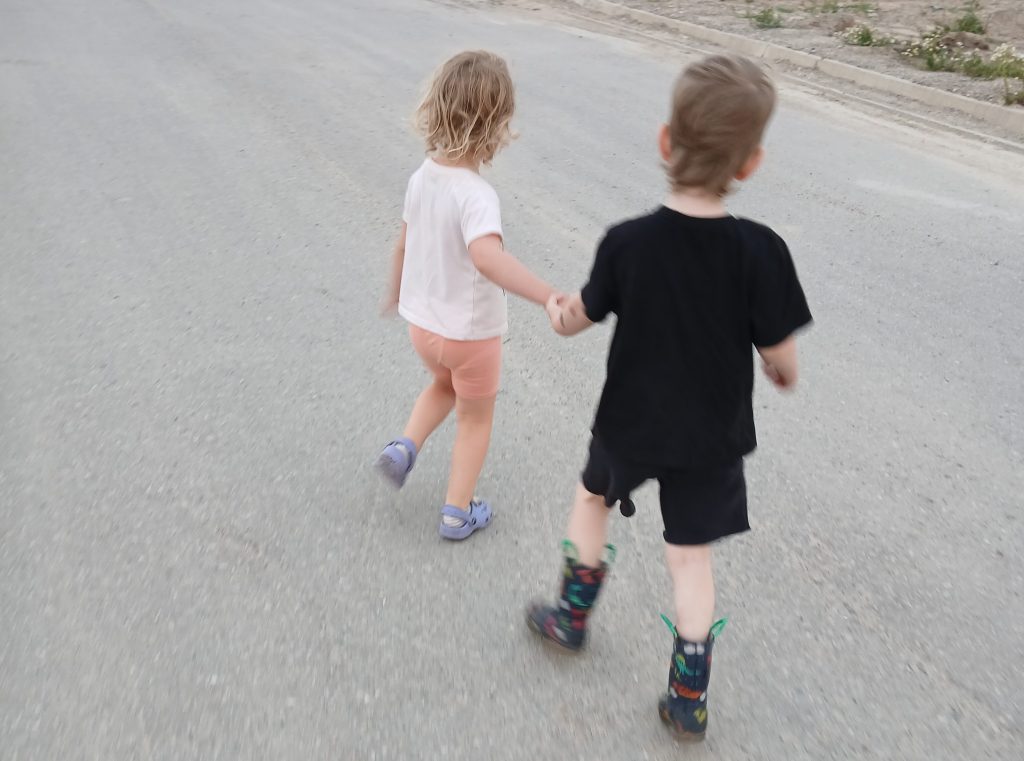
It’s September and the kids head back to school, or in the case of the two youngest grandchildren in our family, begin that journey. Time to think of their future.
I suspect that every generation has its worries about the generation to follow. Elders have long moaned about the failings of youth and have sounded the alarm for society. Even Socrates apparently got into the act, purportedly to have said, “The children now love luxury. They have bad manners, (and) contempt for authority.”
I also hear people speak of hope concerning the next generation, seeing instead a measure of brilliance and a spark much needed for a different future.
My concern isn’t so much about the kids (I fall under the category of having faith in them), but I am concerned about the world they are inheriting from us. Our environment, specifically.
Do you share any of these concerns? Do you feel, like I do at times, overwhelmed by the magnitude of the crisis of climate change? I tell myself that I have given up plastic bags, I drive a hybrid vehicle, I recycle what I can…and then I see pictures of melting ice in the north, emaciated polar bears, or towns devastated by out-of-control wildfires, and my sense of being part of the solution is diminished.
It was with this fear that I participated in a book study to explore author Brian D. McLaren’s Life After Doom, Wisdom and Courage for a World Falling Apart.
No mincing words here: it was a challenging read. McLaren’s writing style made the book approachable and readable; however, the content was not sugar-coated. I am glad I read it with others as part of a book study where we took time to discuss and reflect on the questions provided by the author at the end of each chapter. McLaren outlines, supported by heavily researched and resource-rich documentation, four possible future scenarios that make clear the choice of the word “Doom” in his book’s title.
He does not provide a plan to get us out of this scary future. Nor does he suggest, despite his faith background, including being a pastor, that God will make it alright if we just pray hard enough.
Don’t let McLaren’s pastor roots deter you from reading this book if you are not a church-goer. While he includes reflections in this area, they don’t get in the way of what he is telling the reader about our climate crisis. (If anything, they make clear for the faithful why we need to be engaged in this issue. If you are interested in one minister’s reflections, you can check out this series, “Sermons for a World Falling Apart” on the book at Gale Presbyterian Church in Elmira. )
What McLaren does is take you on a journey into the dark reality of what the changing climate is doing to our world, to our Earth, and to our responding behaviours, and then brings you into a place where you are inspired to work with others and essentially, to not give up.
I think it’s an important book, and thus I am sharing my understanding of what it is telling us over three separate blog posts (there’s a lot to uncover and I don’t touch on it all). I’ll post these weekly during September so the thread isn’t lost while you also have some time between each to absorb what McLaren is telling us.
Through the process of reading the book, sharing thoughts with others, and then delving a little deeper in preparation for writing my blog I learned a lot (including about the development of our complex civilization), I was challenged in my understanding of the issues and what might fix them, I felt some despair, and I felt some hope.
If we are still learning and evolving, as my blog envisions, then I believe we have an opportunity to play an essential role in our families and communities as we face an uncertain future. If for no other reason, I invite you to join this reflection for the sake of your children and grandchildren or any other young people you may know.
***
In the first section of chapters, readers are encouraged to “let go” – to let go of any illusions we may harbour that the crisis isn’t real.
Our world in its current state is unsustainable. In a nutshell, McLaren explains that the world “sucks out too many of the Earth’s resources for the Earth to replenish, and it pumps out too much waste for the Earth to detoxify.” He calls it a state of overshoot. Essentially we have lived like there’s no end to the resources, and we have largely ignored any damage our lifestyles may be inflicting on the Earth and its inhabitants.
McLaren illustrates where we are at by asking us to think about how a tree is chopped down. Even after several wacks of an axe into a strong trunk, the tree will remain standing. For a surprisingly long time. But at some point, a tipping point is reached and one little push, light chop or a strong wind will bring the tree crashing down. Some scientists believe we have reached Earth’s tipping point, that it cannot handle more waste or further removal of its resources, and there’s no stopping the fall. Others believe we have time, but it is running out fast.
Wanting to hide from this reality or denying that climate change exists is actually easy for our brains. As humans, we naturally resist what we don’t understand, or what we can’t imagine. Being concerned about the climate requires that we predict future disasters, and that’s a difficult ask. We may also feel overwhelmed and simply shut down. We may want to avoid what McLaren describes as a “path of descent.” Some of us say – not my problem, I’m too old, let the youth fix it. Some of us think (hope) the problem is exaggerated. Others think “someone” (maybe someone in that smart younger generation) who knows more …or has more money… or has more influence will magically fix it.
McLaren lists in an appendix, 16 different biases we may rely on when it comes to thinking about climate change. For some insight into how our human emotions and bias impact this issue, (and how such behaviours may be hard-wired into us) take 30 minutes to listen to this episode of The Agenda with Steve Paikin. There’s some similarity in what his expert guests have to say and what McLaren’s book tells us.
Despite the gloom, reading McLaren’s book did give me a measure of hope, although even that feeling is complicated as McLaren explains in one chapter. If I rely on that feeling of hope to the point I ignore what is happening across our planet, I won’t be engaged to be part of the solution. Likewise, McLaren states: “Just as hope can give you permission to return to your previously scheduled complacency, so can despair.”
So with a clarity that our future will be changed in foundational ways, along with a measure of complicated hope, McLaren invites us to wake up to a new reality which may be very difficult for many of us to accept.
Where are you on the matter of climate change? Do you think we should be engaged with this issue? Do you worry? Can you identify a bias you may hold concerning climate change?
Next week: Let It Be
***
1. The Literature Network Forums, accessed August. 13, 2025
2. Life After Doom, Wisdom and Courage for a World Falling Apart, Brian D. McLaren, St. Martin’s Publishing Group, New York, 2024
3. Gale Presbyterian You Tube, Sermons for a world falling apart, accessed Aug. 13, 2025
4. TVO today, The Agenda with Steve Paikin, Are We Wired to Deny Climate Change, accessed Aug. 13, 2025
https://www.tvo.org/video/are-we-wired-to-deny-climate-change


 StillKim
Leave a Reply to kimdenstedt Cancel reply