This post is the final and third in a series reviewing the book Life After Doom, Wisdom and Courage for a World Falling Apart by Brian D. McLaren.
***
Were you able to answer the question I posed at the end of my second post – to describe your preferred life situation if the world was ending?
Are you panicking and sequestering yourself with your supplies behind a barricade? Or, are you holding hands with your loved ones, sharing space and time with your family, neighbours, and/or with close friends? Perhaps you are sitting around a dining table, maybe at your cottage by the water, or possibly just in your own backyard enjoying nature.
Are you satisfied that you tried to do what was right by the Earth, and by your descendants?
Perhaps you are still trying to fight the ending, to find ways to preserve a world for the human race?
As I continued to read through the difficult chapters of McLaren’s book, I began to feel that although our world will undergo some profound changes, that perhaps there is a path forward, one of resilience in community if enough of us understand that what we can do, matters. And for that, we must hold onto one another.
In the final chapters of his book, McLaren asks us to “let come” (after we “let go” and “let be” in the first two sections) – that while we can’t guarantee what the future world will be, “we can commit to work for justice, peace, and compassion wherever we are in this world, as long as we live.”
Climate justice is a key part of this picture.
It won’t be easy, because we live in a world with people who are happy with the status quo, in part because it is so tied to our economic wealth. Remember, we are addicted to our cheap fossil fuels.
We can see the beginnings of what McLaren describes will be a “bumpy” ride. I can already identify with the seven different conditions he highlights in the book that we can expect to encounter as “the drama of overshoot continues to play out.”
Consider how susceptible we are to misinformation (1) in our social media curated lives. It’s more important than ever to be savvy consumers of the media we read and watch, always checking sources. Don’t fall prey to memes and comments that simply reinforce your opinion in an echo-chamber.
McLaren suggests that mean-spiritedness (2) will increase and we will need to develop the moral courage to speak up for the marginalized – the immigrant, the LGBTQAI+, the racially and culturally different, the poor. People are afraid that if someone else has rights, they will lose their own. That’s not how it works. This is what makes comedian Steve Carell’s commencement address about kindness to Northwestern University graduates so compelling (and funny!). A simple, timely message delivered in true comedic form.
Dishonesty (3) will abound and we will need to strengthen our character. As Michelle Obama famously said, “when they go low, we go high.” McLaren notes, “When others stoke fear and resentment, we (must) radiate courage and grace.”
Our world, our country, indeed even friendships have become fragmented (4). When others will be tempted to divide and conquer or become dependent upon “autocrats or cult leaders,” we must “develop the skills of interdependence.” There is strength in numbers, particularly diverse numbers, McLaren stresses. Don’t discount the scientists, the lived wisdom of Indigenous peoples, and the educated as you inform yourself.
It will become increasingly difficult to go high when others go low, and we may experience despair (5), but we need to develop the skill and “the courage to differ graciously,” even as we state our position.
My father was a fan of Alvin Toffler’s Future Shock and Dad used to tell us we would continue to see rapid change (6) in our lives. I wish I could chat with him now. I’m sure even he would not believe the speed of change we see today. We must be agile to adapt to the continued multiple changes in our lives. McLaren says “Some changes will feel like losses; others will bring surprising gains.”
Finally, we may begin to feel disconnected (7) from life as we witness the changes. McLaren notes we will need to nourish and “discover new depths of the human spirit,” whatever you call it, religion, spirituality, centredness, or contemplation.
It’s an understatement to say the world is undergoing tremendous change and no longer looks like the industrial-age era that brought in and provided prosperity in the century before this one. Well, prosperity for those of us who bought into the European, colonized definition.
People are afraid.
And fearful people are susceptible to messages of quick fixes, regardless the stripes of the tiger.
Find your people is the essence of one chapter. “It only takes two or three to build an island of sanity in a world falling apart,” McLaren writes.
But he isn’t talking about a cult. If you envision a future often seen in apocalyptic movies where someone amasses food and ammunition and then builds a wall to keep others out, that’s a sure-fire way to speed-up the ending.
Instead, he writes of connecting with others who care about our future: “we need people reaching out and building huddles of sanity and mutual kindness, preparing to share and support each other when turbulence comes and we’re all tempted to be sucked into collective stupidity.”
An excellent example of this connecting can be found on a recent episode of CBC’s What on Earth with Laura Lynch. The program features stories from around the world of people trying to fight climate change.
The recent episode that caught my attention featured listener Adrienne Crowder who took a free university course on climate change that the program had promoted.
Adrienne tells Laura that the course “fuelled my fire – realizing, ah, I am not alone. I’m not the only one trying to fight the world. There’s a whole group of people in their own little sectors doing their thing and when we band together, we become this beautiful mosaic of people doing great work which inspires all of us … and we feel good and when we feel good we do good…. It is so easy to get utterly overwhelmed and depressed if you feel like you are alone trying to combat climate change and big oil and whatever…But when you learn there are other people who are not only similarly concerned but who are actually doing some really cool things in their part of the world, that’s inspiring … it keeps me going.”
Western University offers this free course and you can register here or sign up to be notified when the next course runs. I’ve signed up to be notified for their September 2025 course offering. The University website describes the course “Connecting for Climate Change Action is a course that uses a storytelling approach to bring Western and Indigenous Sciences together to educate, encourage discussions, and motivate action on climate change. This innovative, experiential, online learning opportunity engages and stimulates learners to action to mitigate climate change.”
Do you know your neighbours? Do you maintain connections with former colleagues? Do you have a church or club or group that you meet with regularly? In any emergency, including the impending changes we are witnessing due to climate, we are better when we work together, not every person for themselves. If you have such a group, you might consider reading this book and discussing it together, or signing up to take the free course.
As adults who have lived a good piece of our lives already, we might be susceptible to thinking it’s too late or we know it all, but McLaren has a special message for us: “if you don’t keep maturing in wisdom, you will not remain at your current level of awesome. Like an egg that doesn’t hatch, your awesome level will, I’m sad to say this – decline along with civilization.”
In the face of the despair we may feel, it is important to realize that what we can do does matter.
McLaren introduces readers to musician Michael Franti who sings in one of his songs, ”There’s a billion different people doing a billion different things to make a billion places better today” and ”We can be part of the change.” The title of Franti’s song, “The World is so F*cked Up (But I Ain’t Never Giving Up On It) delivers a message worth listening to in an engaging tune. You will find yourself smiling and perhaps even singing along after listening to it. In fact, McLaren devotes one chapter to the importance of art, music and poets in our lives.
McLaren entreats the reader to light their own candle and to consider this is a great time to be alive. Borrowing the line from the song, he suggests if a billion of us do a billion things then maybe in the “dance of life,” there will be a way forward in a world that is going to look very different some day.
McLaren’s book does not outline a plan for everyone to follow, but he does have a lengthy list of suggestions for us to develop our own plans, based on our own areas of interests and strengths. One of these is the “plan to use your voice and exercise your right to not remain silent” and thus, I decided to use my blog to write about McLaren’s book and attempt to provide some sort of summary of what he has to offer to the discussion about climate change. I plan to use some of my future posts to celebrate some of the “billion things” that people are doing to make the world a more habitable place. I am giving thought to another, “Your plan to improve your diet for your own health and planetary health” because listening to Sidney Smith’s video has strengthened my resolve to eat locally and seasonally rather than supporting industrialized farming practices. Small steps. I continue to keep the book close and review its messages along with taking the university course. It’s part of my plan to keep learning about overshoot.
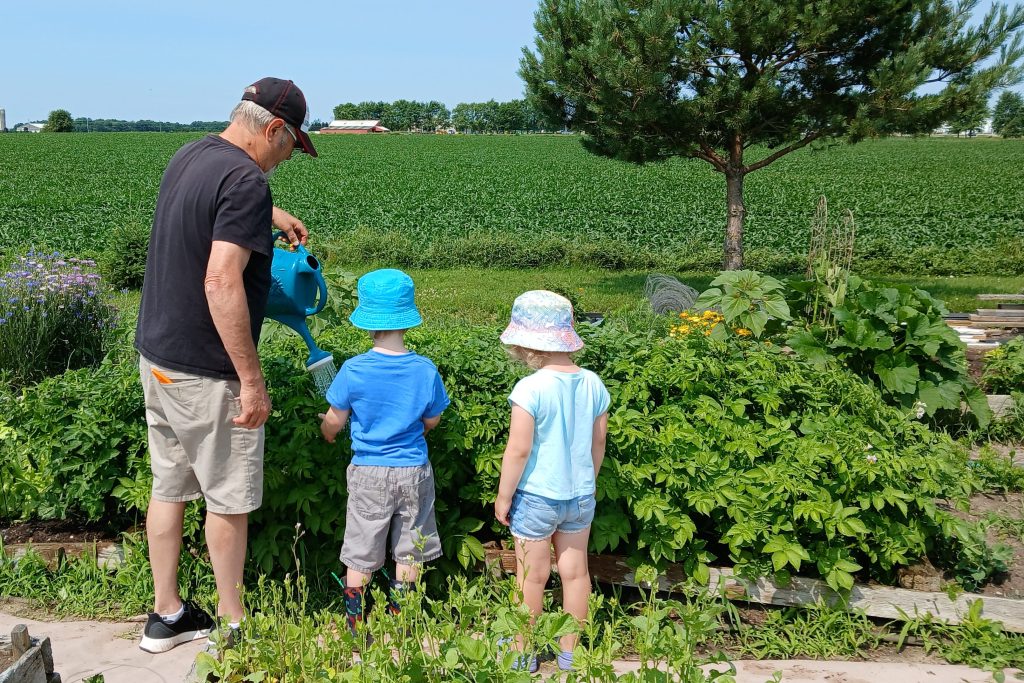
Will the kids be alright? It’s where I started my reflection and the question the title of this series asks. The answer: I don’t know, but I am committed to do what I can to contribute to a better future for my grandchildren choosing to believe that what I can do, will matter.
In the meantime, can you share the ways that you preserve our Earth? How do you contribute toward the billion different ways people make the world a better place for future generations? Please use the comment section below so we can all share with and learn from each other.
***
1. Life After Doom, Wisdom and Courage for a World Falling Apart, Brian D. McLaren, St. Martin’s Publishing Group, New York, 2024
2. Facebook post, featuring Steve Carell https://www.facebook.com/reel/1907663633317980; original posting @cspan.
3. CBC Radio, What on Earth with Laura Lynch
https://www.cbc.ca/radio/whatonearth
4. Western University, London, Ontario. https://geoenvironment.uwo.ca/undergraduate/course_information/new_course_connecting_for_climate_change_action.html
5. Michael Franti and Spearhead, This World Is So F*cked Up (But I Ain’t Never Giving Up On It) https://www.youtube.com/watch?v=QrPQfNjeHlo


 StillKim
Leave a Reply to kimdenstedt Cancel reply