Have you ever felt like unplugging from the rat race, or stepping off the merry-go-round, or however you might express the metaphor for a deeply held feeling that you’d like to get away from it all? I’d be willing to bet there’s a few of us who would confess to such escapist-type thoughts, but very few of us who have actually done it. Maybe for a weekend or a short-term holiday, but as a permanent approach to life?
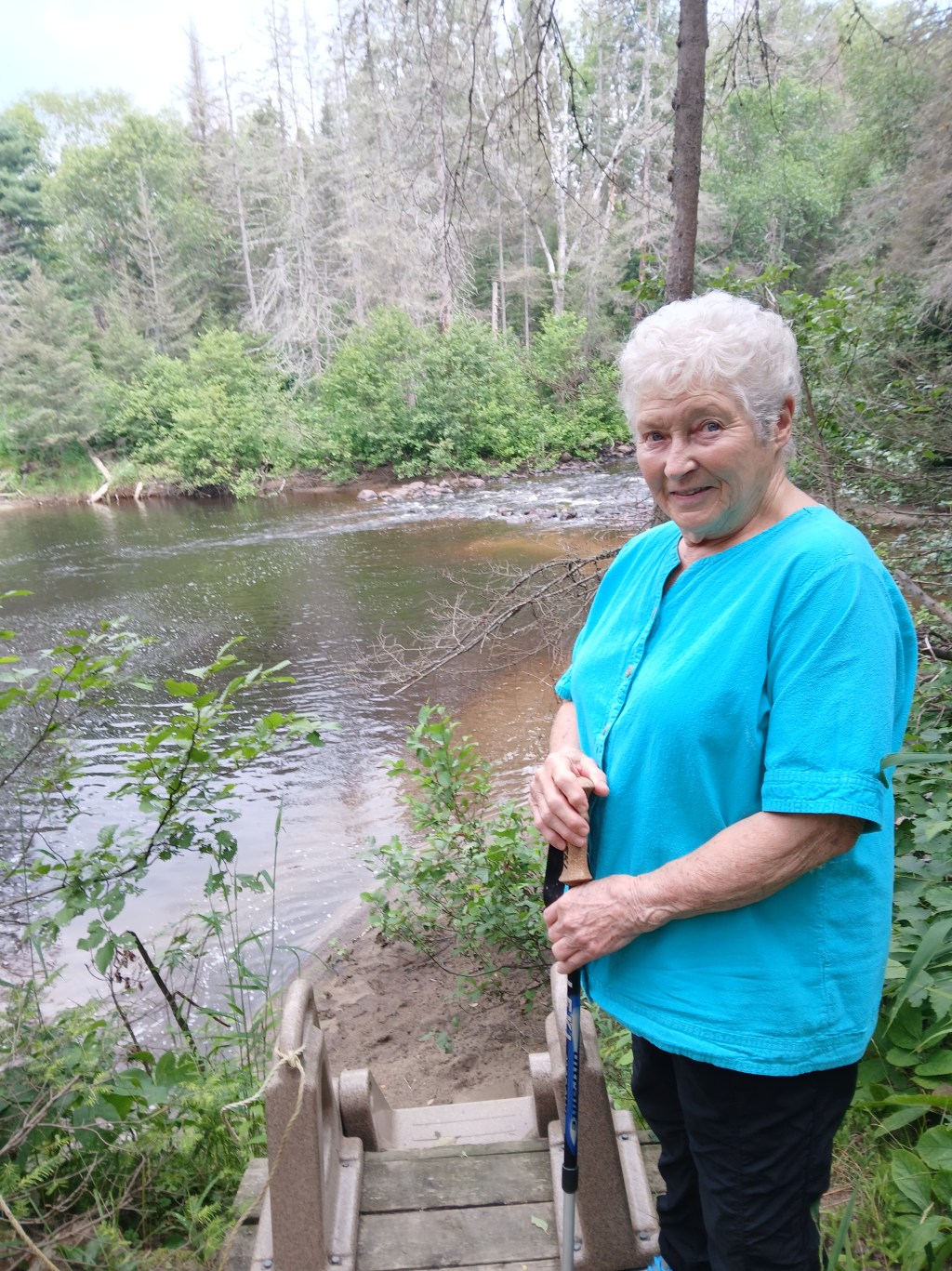
I recently had the pleasure of chatting with a woman who has led a remarkable, off-the-grid life since her retirement 21 years ago. She lives alone, and annually stacks 23 cord of wood, fills two propane tanks, and stores the power from six solar panels to support her way of life throughout four seasons in north-central Ontario.
I would call Marion Duke inspiring for doing this at any age. She turned 86 this summer.
The log home she and three brothers built sits on land that has been in the Duke family since the 1870s, on the bank of the north branch of Magnetawan River where she can be found swimming in the summer months. She was six when her parents decided to leave the Sundridge area property and move their family of nine children south to a farm in Howick Township. Better farm land and access to education drove her parents’ decision: sandy soil could not be farmed making it difficult to carve out a living to support a family, and they would have had to board their children in order for them to attend high school – a cost that would have been prohibitive.
They left in mid-November, 1946, the two oldest boys driving a truck with the cattle, Marion remembers. The seven remaining children and their dog were in the family Pontiac which got them as far as Orangeville before it gave out. They taxied the remaining distance of about 100 kilometres only to discover the family that had sold to them had not moved out yet!
Not only was it the days before mobile phones, it was a time when some people, the Dukes included, still did not have land lines. “Remember, there was no telephone communication from our end, ” Marion explains. “I only remember Mom and Dad putting mattresses on the floor for us to sleep on. We were so tired.” The predicament of two families temporarily sharing the space was resolved, but her father had to hitchhike back to Orangeville to get the car.
Marion says the difference the move made in their lives is unimaginable, and she shared amusing memories that illustrate the contrasts. Marion remembers people wondering about their snowshoes. What were they and why did they have them? For the Duke children, they were a winter necessity, helping them to traverse the 2 1/2 miles to school through snow. On the other hand, hydro was a novelty for the Duke children when it was eventually installed at the farm. In the bedroom she shared with her sisters,“There was a light bulb in the ceiling above the bed and we were told you had to pull the string for the light to come on. We argued about which one of us was going to get to hang from the string to keep the light on!” Then her father surprised her mother with a washing machine, something she had not owned previously. (Sit with that for a moment – nine children and no washing machine!)
Her father’s commitment to education, as a school trustee in Sundridge, and the decision to relocate family to farmable land, paid off. All the children, including the 10th born after the move, finished high school and several went on to university, including Marion.
The move brought modern technology and enhanced future possibilities into their lives, but it wasn’t without sorrow or challenges. Just three years after the move, in 1949, her father died of pneumonia. Marion remembers him coughing blood and the Doctor wanting proof of payment before he would be admitted to hospital. It’s a memory that underlines for Marion the value of the Canadian health system today. Her mother continued to farm with assistance from the older children; however, “I can remember my mother taking food off her plate to feed her children.”
Marion enrolled for a second year of Grade 13 so she could earn money to study journalism at Western University in London where she had been accepted. She used the time to study typing and short hand, skills she would need as a reporter. Staying close to her mother who was blind in one eye, and the fact there were still younger brothers at home, brought Marion back to the area following graduation. She began work at The Listowel Banner in 1964. Her mother died in 1975 at the age of 67.
A teacher had encouraged Marion to study English, but she saw journalism as a profession that would use her skills and provide a route to earning a living. It was not her first choice. She had wanted to join the air force until career day when they told her she could not be a pilot because she was a woman.
Young women today might find it hard to believe that such roadblocks existed. While Marion did experience some resistance in her job because of her gender, she doesn’t dwell on it. There’s one story she shared that seems amusing today. She was invited by the Fordwich Orange Order to take a picture and when she knocked on the door, the person who opened it took a look at her, said “It’s a woman,” and promptly shut the door. From outside she could overhear the ensuing concern. “There was quite a kerfuffle and discussion and someone said, ‘she’s only here to take a picture.’ And finally they opened the door. So, I was the only woman to ever set foot in that building,” she chuckles.
A little over a decade later is when I first encountered Marion when I was starting out as a young student journalist. I got a summer job working at the newspaper and after that summer experience, I was confident in the path I had chosen for myself. I can attest that things had not changed too much for women though as I eventually had my own similar encounter with a Lion’s club in near-by Wingham. Marion and I compared first-day-on-the-job stories. Marion was given a typewriter that had no letters or numbers on the keys and a stock report to write-up! That beats my story. I recall asking her if I could hand-write a draft before typing (at least my typewriter had the letters and numbers on the keys). Her hesitant, drawn-out “okay” and doubtful look made it clear that I would have to learn to write on the typewriter, a necessary skill in the fast-paced newsroom. They hired me for a second summer so I must have learned the trick! For younger readers who may not understand the significance, editing an error or changing one’s mind about how to order a story’s content meant starting all over again on a typewriter – it wasn’t like a computer with cut and paste features!
Marion’s mentor was Cy Bamford; “a real newspaper man,” is how she describes her first editor. Her journalistic instincts were sharpened under his tutelage. She tells the story of how she was asked to leave a police board meeting while they discussed an ugly strike that was happening at a local company, Spinrite Yarn. Cy taught her that they needed a legal reason to remove her, and once she understood her role and right as a journalist, she was never asked to leave another meeting.
Her education supported her convictions concerning the role of the media, even in a small town. When told by a subsequent owner who didn’t have a newspaper background that if a prominent person in town were ever arrested that she could not cover the story, she retorted, “If that’s your opinion, you should be across the street selling shoes. And I would quit.
“Some community newspapers ignore the issues, we did not. There’s nothing that happens in cities that doesn’t also happen in small towns,” she observes. Including murder.
Her decisions about how to cover the issues were not without controversy. “A reporter had his tires slashed when we covered one trial, three days in a row. I had nails pounded into my tires twice.
“I got raked over the coals a lot, but I was also recognized when we were trying to inform.”
The town’s respect for the former editor was evident when they invited her back to officially open the town’s 150th anniversary celebrations in the summer of 2025. She was with The Banner for 41 years, a noteworthy career that recorded the best and the worst of the town’s history.
After retirement she traded the journalist’s role for politics and served a four-year term as a councillor on Joly Township council. She is proud that during her term township staff were enrolled in retirement plans, an official plan was passed, and solar panels were installed. She remains interested in all levels of politics, and has strong opinions about the age of politicians. “You can’t be too young – you need to understand what it takes to make a living. I also have a firm opinion you should not be in a leadership role beyond the age of 74. When you hit that age you simply don’t have the energy. Besides that, when do you let the next generation move in and take on those roles?”
Living off the grid occupies much of her time now. Read more about how Marion manages her off-grid lifestyle in a follow-up post next week!


What do you think?